Built for Singapore CSPs

KYC Software
CSP Singapore

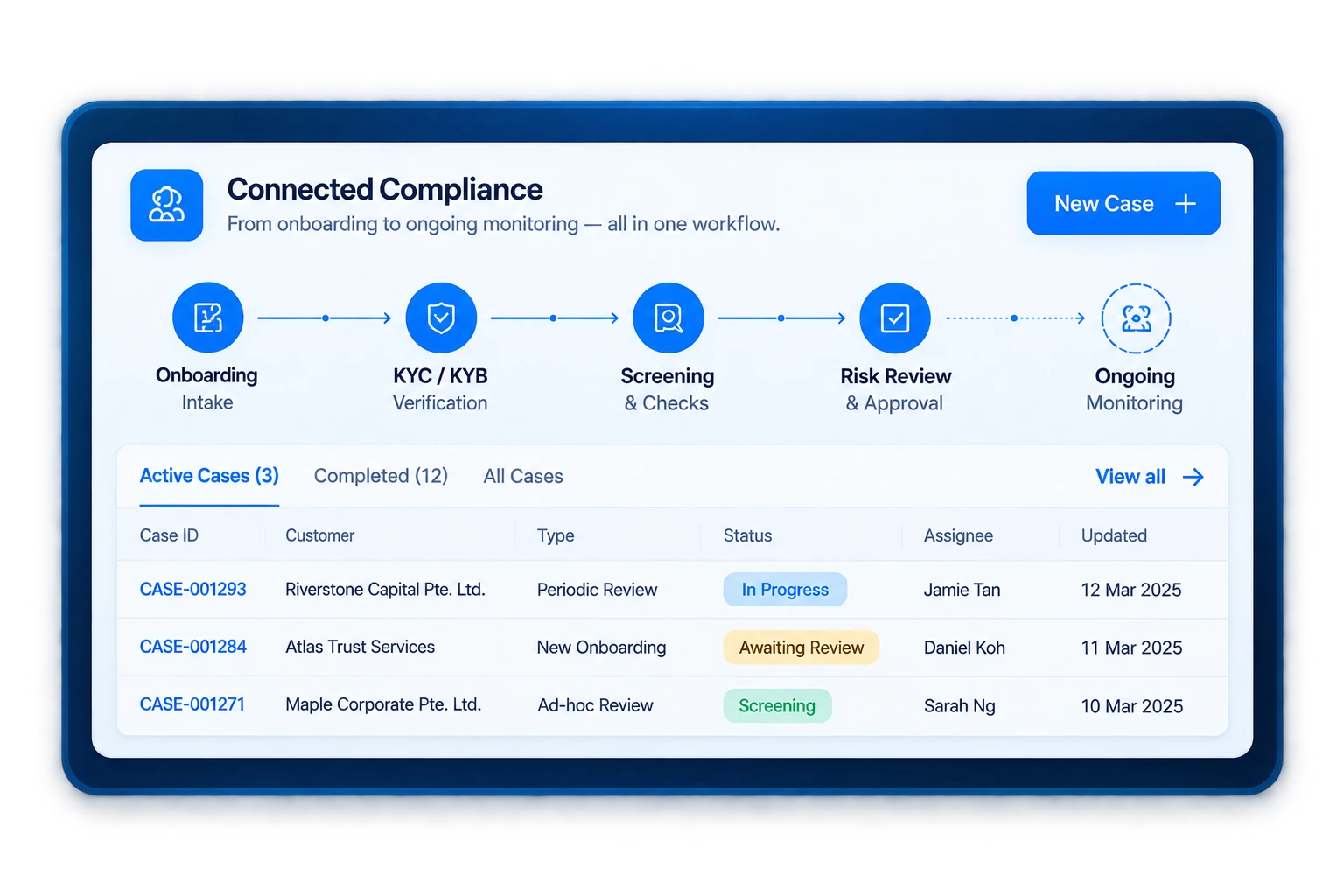
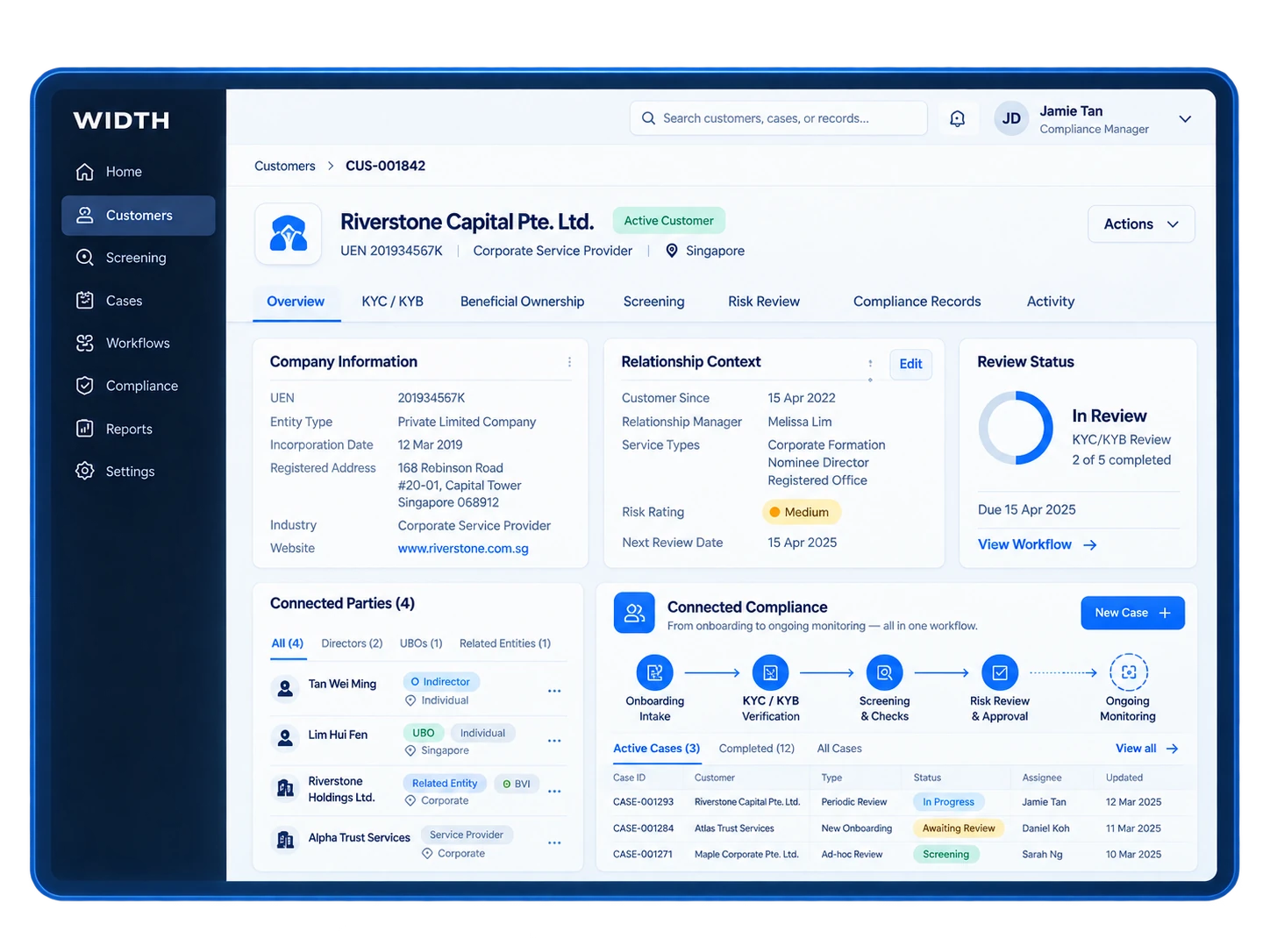
Manage KYC, KYB, beneficial ownership, screening, risk review and compliance records in one connected workflow.

Built forCompliance Teams
ISO/IEC 27001Information Security
OperationalVisibility
ConnectedCompliance
Compliance for a brighter tomorrow
WIDTH customer compliance dashboard for Singapore CSPs WIDTH connected compliance workflow dashboard
TRUST
PEOPLE
PROGRESS
A SAFER SINGAPORE
AI / TRUST / PROGRESS / SINGAPORE
Built on proven Singapore RegTech experience.
500+Institutions supported*
180Jurisdictions covered*
100+Data integrations
ISO 27001Security-led operations
* Including the operating history and customer relationships of Cynopsis Solutions.
What Singapore CSPs need

Build around the actual review

Singapore CSP compliance is broader than an identity check. ACRA reviews how registered CSPs assess risk, verify customers, collect beneficial ownership information, maintain controls and report suspicious transactions. WIDTH is designed to connect those operational steps instead of leaving them across separate tools.

ACRA review areasCurrent official guidance
Risk assessment

Assess money laundering, proliferation financing and terrorism financing risk.

Customer identity

Verify customer identities and conduct enhanced checks where required.

Beneficial ownership

Collect and provide beneficial ownership information.

Suspicious transaction reporting

Maintain a process for identifying and reporting suspicious matters.

Internal controls

Maintain policies, procedures, controls, staff communication and training.

Built for Singapore CSP teams

Built around real CSP work

This page is designed for teams managing customer due diligence across growing corporate client portfolios, not for one-off identity checks.

Company incorporation clientsManage new corporate relationships with structured KYC and KYB review.
Corporate secretarial relationshipsKeep customer and entity records connected after onboarding.
Directors and shareholdersReview the people connected with the company in the same relationship context.
Beneficial ownersKeep ownership information close to screening and risk review.
Nominee arrangementsSupport structured review, evidence and internal escalation where required.
Cross-border structuresMaintain a clearer record when the relationship involves multiple entities or jurisdictions.
Periodic client reviewsContinue customer risk review after initial onboarding.
Higher-risk customer casesMove complex matters into case management instead of email and spreadsheets.
Connected workflow

See the workflow clearly

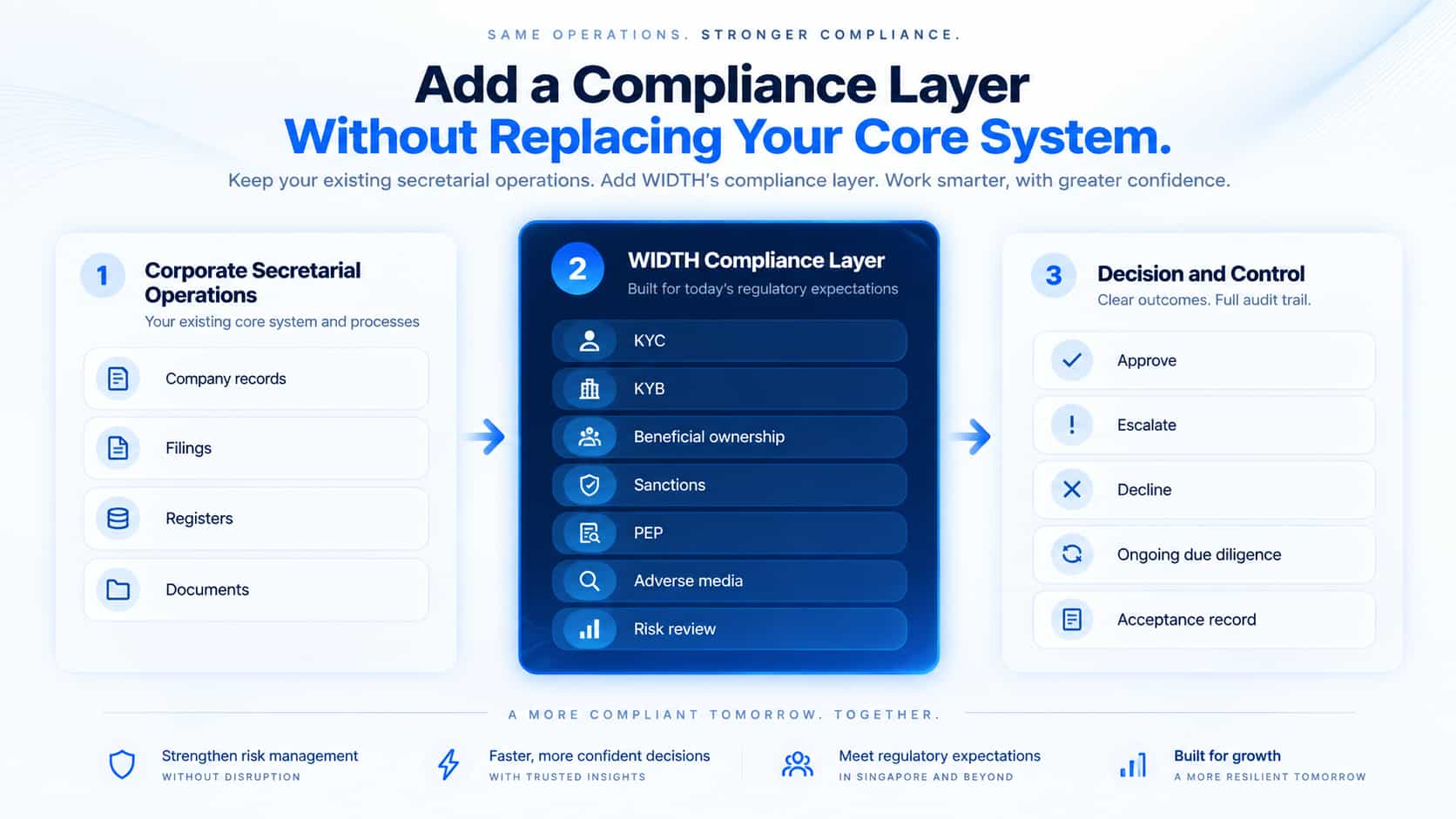
WIDTH keeps KYC, KYB, screening, risk review and reporting inside one connected process for Singapore CSP teams. The workflow visual shows the operating model. The framework below shows how the work moves towards a documented customer result.

Book a CSP Demo
WIDTH CSP Compliance WorkflowOperational view for Singapore client onboarding and review.
WIDTH CSP compliance workflow Singapore
Customer due diligenceBeneficial ownership reviewScreening operationsRisk and approval workflowAudit-ready record
Workflow to result

From review steps to documented outcome

Each stage feeds a structured output so the CSP can move from intake to decision without losing evidence, ownership or context.

INTAKECollect the right informationGather the customer, entity and supporting information needed to open the review.
VERIFYConfirm identity and entityRun KYC and KYB checks within the same relationship context.
SCREENReview relevant risk signalsAssess sanctions, PEP and adverse media signals alongside customer context.
REVIEWApply compliance judgementDocument risk observations, escalations and reviewer judgement.
DECIDERecord the customer outcomeRetain the decision rationale for internal control and audit readiness.
Result

Customer outcome, fully documented

The workflow should end with a clear decision and a usable record. That means accepted, escalated or declined status can be supported by evidence rather than reconstructed later.

Instead of leaving the team with screenshots, email approvals and disconnected notes, WIDTH helps keep the review history and decision record in one workflow-led environment.

Reporting outputCustomer Detailed Risk ReportA structured record of KYC, KYB, ownership review, screening outcomes and reviewer observations.
Decision outputCustomer Acceptance FormAn internal record covering outcome, rationale, approval ownership and the next action on the relationship.
WIDTH for CSPs

One platform for the client lifecycle

Explore the workflow by capability. Each section is built around what a CSP team actually needs to manage, not a feature catalogue.

Manage the whole relationship

Keep customer data, business information, connected parties, review status and follow-up activity within one operational record.

See KYC and KYB context together
Keep directors, shareholders and beneficial owners connected
Track review status, approvals and future review activity
Reduce spreadsheet and email hand-offs
Customer management
WIDTH CSP customer management interface
Customer recordConnected partiesReview visibility

Keep screening in context

Bring screening results into the customer review instead of storing alerts in a separate tool. This gives reviewers the customer, entity and ownership context needed for a more informed assessment.

Connect screening to KYC and KYB records
Route matches for review and escalation
Maintain reviewer notes and decisions
Screening reviewCUSTOMER CONTEXT CONNECTED
Adverse media reviewPotential negative-media signal routed for assessment
REVIEW
Risk factorsCustomer profile and relationship context available to reviewer
VIEW
Decision recordReviewer outcome and evidence retained with the client record
LOG

Review PEP relationships clearly

Potential politically exposed person relationships may require additional assessment. WIDTH helps keep the screening result, customer context, supporting evidence and reviewer decision connected.

Identify potential PEP matches for reviewer assessment
Document additional due diligence where required
Record escalation, rationale and approval
PEP reviewRISK-BASED WORKFLOW
Potential PEP matchRelationship requires reviewer assessment
PEP
Additional informationSupporting information and review notes kept together
EDD
ApprovalDecision ownership and rationale recorded
LOG

Screen relevant parties together

Sanctions screening is more useful when the reviewer can see who the person or entity is, how they relate to the client and what action was taken on the result.

Screen customers and relevant connected parties
Review potential matches with ownership and entity context
Keep the final reviewer outcome in the same record
Sanctions reviewCONNECTED PARTY SCREENING
CustomerPrimary relationship screened
OK
DirectorConnected party screening result available
OK
Beneficial ownerPotential match routed for analyst review
REV

Investigate without losing context

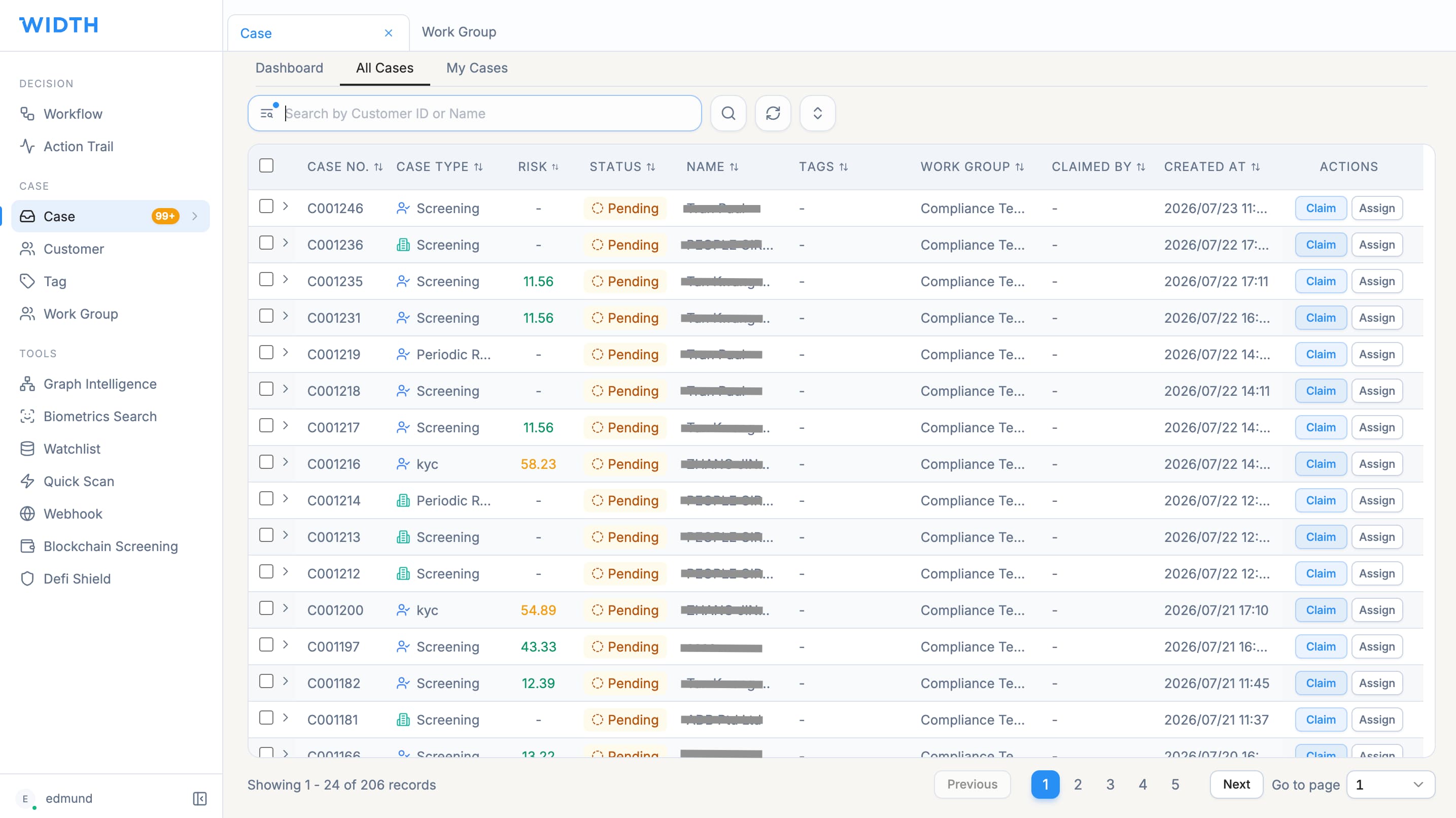
When a review needs more evidence or escalation, move it into a structured case workflow while keeping the customer relationship, screening history, notes and decision trail connected.

Structure escalations and follow-up
Keep evidence and reviewer notes together
Maintain a clearer audit trail of actions and decisions
WIDTH case management interface

Turn reviews into usable records

Give compliance teams structured outputs for internal review, customer acceptance and audit preparation instead of rebuilding the history from screenshots and email threads.

Customer Detailed Risk Report
Customer Acceptance Form
Decision rationale and reviewer ownership
Supporting evidence retained with the relationship
RISK REPORTCustomer Detailed Risk Report
ACCEPTANCECustomer Acceptance Form
Connected platform view

One platform for the client lifecycle

Keep the same customer context visible across onboarding, screening, review activity and case handling instead of reconstructing the relationship across disconnected systems.

WIDTH unified CSP compliance backend
One customer contextConnected review activityOperational visibilityOne source of truth
Operational change

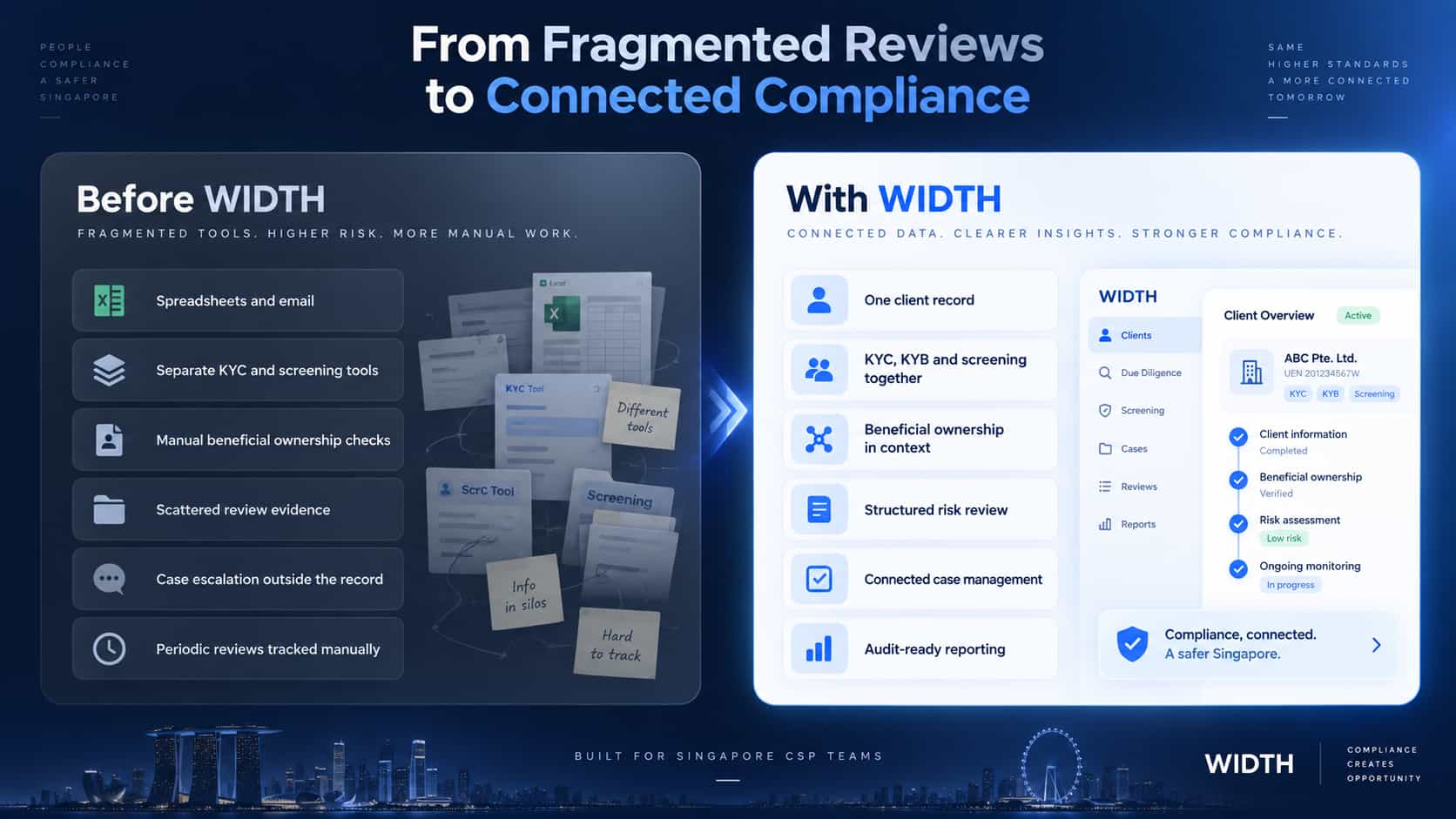
Replace fragmented CSP compliance

The commercial value of KYC software is not another dashboard. It is reducing the number of disconnected places your team needs to work in to complete and evidence a customer review.

Before WIDTH

Separate tools and manual hand-offs

Client data spread across spreadsheets, email and shared folders
KYC and screening managed in separate systems
Beneficial ownership reviewed outside the main customer record
Approvals and evidence stored as screenshots or email trails
Case escalation disconnected from onboarding
Periodic reviews tracked manually
With WIDTH

One connected compliance workflow

KYC, KYB and screening connected to one customer relationship
Beneficial ownership stays within the wider review context
Risk assessment and escalation follow a structured workflow
Case activity remains linked to the customer record
Reporting outputs support risk review and acceptance
Ongoing review activity stays visible to the team
Ongoing due diligence

Keep client risk under review

KYC is not finished when a customer is accepted. CSP teams still need a controlled way to revisit the relationship, record changes and keep the review history visible over time.

Keep the relationship current

Use the same customer context for future review activity rather than rebuilding the file each time.

Periodic reviewsTrack future review activity based on the firm's own policies and risk approach.
Ownership changesRevisit directors, shareholders or beneficial ownership when the relationship changes.
New risk signalsAssess new screening information in the context of the existing customer record.
Review ownershipKeep responsibility, notes and outcomes visible to the compliance team.

Ongoing review without rebuilding the file

WIDTH helps keep the customer record, screening context, risk review and case history connected so later reviews start with the relationship history already available.

Support periodic customer review workflows
Keep historic decisions attached to the relationship
Route material changes for additional review when required
Maintain clearer evidence for internal oversight and audit preparation
Decision outputs

Do not stop at a screening result

A useful CSP KYC workflow should finish with a decision record your team can review, approve and retrieve later.

ProfileCustomer information
VerifyKYC and KYB
OwnershipDirectors, shareholders and UBOs
ScreenSanctions, PEP and adverse media
AssessRisk review
DecideApproval or escalation
RecordStructured compliance output
Risk record

Customer Detailed Risk Report

Bring customer, business, ownership, screening and reviewer observations into a structured record that supports internal review.

Decision record

Customer Acceptance Form

Keep the customer outcome, rationale, approval ownership and next review action in a clear internal record.

Singapore CSP Requirement Centre

Read the rule. Map the workflow.

This section separates the official requirement from the operational workflow. Use the ACRA and Singapore Statutes Online links to read the source material directly.

Customer due diligence

The CSP Act requires a registered CSP to perform customer due diligence before providing a corporate service, and in other prescribed or risk-triggered circumstances. The Act defines CDD to include identifying and verifying the customer and the customer's agent, identifying and verifying beneficial owners, and obtaining information on the purpose and intended nature of the business relationship.

What the CSP needs operationallyA controlled process for customer identity, entity information, ownership context, supporting documents and decision records.
Where WIDTH helpsKYC, KYB, customer records, workflow, evidence and review activity can be managed in one connected environment.

Beneficial ownership

ACRA's compliance review framework examines how CSPs collect beneficial ownership information and how well they provide beneficial ownership information to ACRA. The CSP Act's CDD definition also includes identifying every beneficial owner and verifying their identity.

What the CSP needs operationallyClear ownership and control information linked to the company and the individuals behind it.
Where WIDTH helpsKYB, connected parties and beneficial ownership review can remain attached to the same customer relationship and case history.

Risk assessment

ACRA's compliance review framework examines risk assessment methods for money laundering, proliferation financing and terrorism financing. ACRA's CSP guidelines also explain the use of risk factors and risk-sensitive enhanced CDD.

What the CSP needs operationallyA repeatable way to capture risk factors, apply the firm's methodology, escalate higher-risk relationships and keep the rationale.
Where WIDTH helpsRisk scoring, review workflow, evidence, escalation and decision history can be connected to the customer record.

Suspicious transaction reporting

ACRA's review framework includes how the CSP reports suspicious transactions. The CSP Act also requires compliance with prescribed requirements for recording and reporting transactions suspected to involve money laundering, proliferation financing or terrorism financing.

What the CSP needs operationallyA structured investigation path that retains evidence, reviewer actions, escalation and the reporting decision.
Where WIDTH helpsCase management and investigation workflows help keep the underlying customer context, evidence and decision trail together.

Internal controls

ACRA reviews internal policies, procedures and controls, how these are shared with staff, and the scope and frequency of staff training. Software does not replace those responsibilities, but it can make the operating process more consistent and visible.

What the CSP needs operationallyClear ownership, consistent workflows, accessible evidence and a reliable record of what was reviewed and decided.
Where WIDTH helpsStructured workflows, case records and one source of truth can reduce fragmented hand-offs and improve operational visibility.

Bring your current CSP workflow to the demo

Show us how your team handles onboarding, beneficial ownership, screening, risk review and case escalation today. We will map the workflow against WIDTH and show where the operating process can be connected.

Book a Singapore CSP Demo
Why WIDTH

Match the workflow to the requirement

The strongest reason to choose WIDTH is not that it performs one check. It is that the platform can connect the work a CSP needs to perform across the client lifecycle.

Requirement
Operational need
WIDTH capability
Customer due diligence
Collect, verify and retain customer and business information.
KYC, KYB and customer onboarding workflows.
Beneficial ownership
Understand the people behind a corporate customer.
Connected-party and ownership review within the KYB workflow.
Sanctions / PEP
Screen relevant parties and review potential matches.
Sanctions, PEP and adverse media screening connected to the client record.
Risk assessment
Apply methodology, document risk and retain rationale.
Risk scoring, review workflows, escalation and decision records.
Investigation
Handle exceptions and suspicious matters consistently.
Case management, evidence and investigation workflows.
Audit readiness
Produce a clear history of checks, evidence and decisions.
Structured records and one source of truth.
AEO FAQ

Questions Singapore CSPs ask

Clear answers for buyers, compliance teams and ACRA-facing operations.

What is KYC software for a Singapore CSP?
KYC software for a Singapore Corporate Service Provider helps the firm manage customer due diligence in a structured way. Depending on the platform, this can include KYC, KYB, beneficial ownership review, sanctions and PEP screening, risk assessment, case management and compliance records.
What does ACRA expect a registered CSP to review?
ACRA's compliance review framework examines eight areas, including risk assessment, internal policies and controls, customer identity verification, beneficial ownership information, suspicious transaction reporting, staff communication and training.
When must a Singapore CSP perform customer due diligence?
Section 17 of the Corporate Service Providers Act 2024 requires customer due diligence before providing a corporate service, when the CSP suspects money laundering, proliferation financing or terrorism financing, when earlier information may be unreliable or inadequate, and in other prescribed circumstances.
Does customer due diligence include beneficial owners?
Yes. The CSP Act defines CDD to include identifying every beneficial owner of the customer and verifying the beneficial owner's identity, alongside identifying and verifying the customer and the customer's agent.
Can WIDTH support both KYC and KYB?
Yes. WIDTH supports KYC and KYB workflows so a CSP can manage individuals, businesses and related-party information within a connected compliance workflow.
Can WIDTH support beneficial ownership review?
Yes. WIDTH can support connected-party and beneficial ownership review within the wider KYB and customer-risk workflow, keeping ownership context closer to the client record.
Can WIDTH support sanctions screening?
Yes. WIDTH supports sanctions screening as part of the wider onboarding and risk-review process, allowing results and reviewer actions to remain connected to the client relationship.
Can WIDTH support PEP screening?
Yes. WIDTH supports PEP screening and can route potential matches into review and escalation workflows where the CSP's policies require further assessment.
Does WIDTH support adverse media screening?
Yes. Adverse media screening can form part of the wider customer-risk review, giving reviewers additional context when assessing the relationship.
Why does a CSP need case management?
Some customer relationships require additional evidence, escalation or investigation. Case management helps keep that work structured so actions, notes, evidence and decisions do not disappear into email or spreadsheets.
Can WIDTH help with ACRA compliance reviews?
WIDTH can support the operational process by helping teams organise customer records, screening results, risk reviews, case history and evidence. The CSP remains responsible for its legal and regulatory obligations.
Does KYC software make a CSP compliant?
No. Software supports the compliance process. It does not replace the CSP's policies, controls, professional judgement, staff training, escalation decisions or regulatory responsibility.
What should a CSP look for when choosing KYC software?
Look beyond identity verification. A practical CSP platform should support KYC, KYB, beneficial ownership, screening, risk assessment, case management, ongoing review, reporting and retrievable decision records.
Why use one platform instead of separate KYC and screening tools?
A connected platform can reduce manual hand-offs and make the customer relationship easier to understand. The main advantage is operational visibility: customer data, screening results, review activity and case history can remain within one source of truth.
The Future of Risk Intelligence

Bring CSP compliance into one workflow

See how WIDTH can support KYC, KYB, ownership review, screening, risk assessment, case management and reporting for Singapore CSP operations.

One Platform. One Workflow. One Source of Truth.
See WIDTH on your CSP workflowBook a Demo