Malaysia · MSB and e-money workflows
Payment Compliance Software in Malaysia
Connect customer risk, payment activity and investigations around one record. Evaluate WIDTH for the evidence, review process and deployment boundaries your Malaysian payment operation needs.
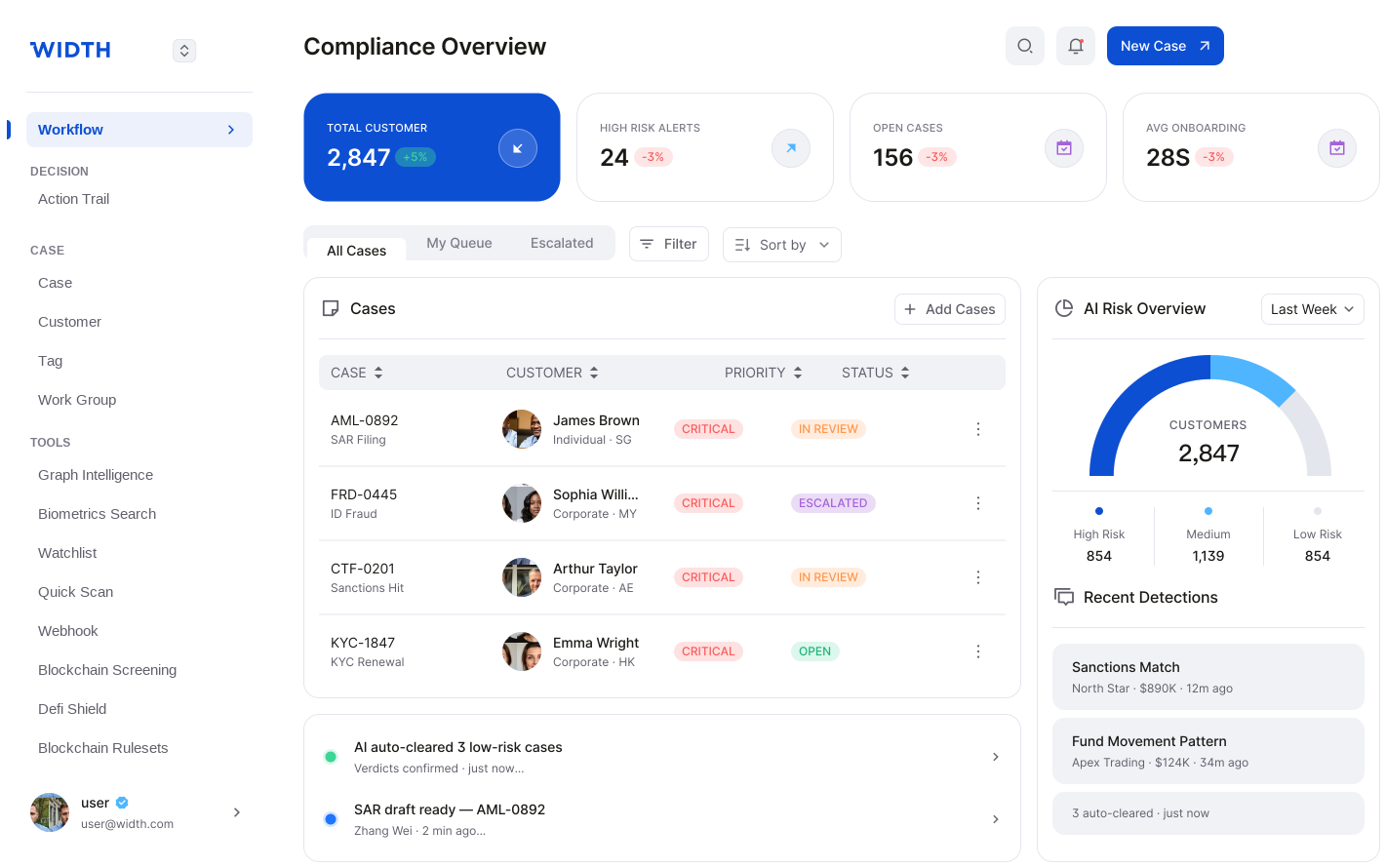
For a Malaysian payment business, start with its regulatory category and the policies that apply to it. An MSB journey and an e-money journey can share information while requiring different controls. Software should help reviewers connect evidence without implying that one template fulfils every BNM requirement.
Start with the operation you run
Define the service, customer relationship and sources of payment activity before selecting a monitoring configuration.
Money services businesses
Test customer and beneficiary context around remittance or money-changing activity, including how exceptions are reviewed.
E-money operations
Follow the available customer information through relevant funding, wallet and payment events. Check that the proposed feeds cover the journey.
Merchant and business relationships
Connect KYB, ownership and settlement context to unusual activity. Establish which obligations apply to the entity rather than assuming all payment businesses share one category.
Keep BNM policy scopes and dates clear
Bank Negara Malaysia’s (BNM’s) AML/CFT/CPF and TFS policy for financial institutions lists licensed MSBs and approved issuers of designated payment instruments among its applicable institutions. Its risk-based framework is a policy starting point; confirm how it applies to the entity and service being assessed.
Approved e-money issuers should also examine the BNM E-Money policy revised in January 2025. Separately, the Technology Requirements for Payment Services Regulatees policy, issued on 12 March 2026, has an effective date of 12 March 2027. Preparation for that policy should be distinguished from current AML obligations; a monitoring product alone is not the entire technology-control programme.
Test the complete wallet activity trail
Illustrative demo scenario: an e-money customer’s funding and outgoing activity changes, and the analyst cannot yet explain the pattern. The example is a test case, not a customer outcome or an accusation.
Confirm the event coverage
Identify which funding, wallet and outgoing-payment events enter the proposed workflow, including failed or rejected records.
Bring the customer history
Retrieve relevant customer information, expected use and earlier findings alongside the activity.
Investigate the pattern
Examine counterparties and explanations, record missing information and escalate the unresolved questions.
Retain the review trail
Keep evidence, reviewer actions and follow-up with the decision. Agree which exports and records can actually be produced.
One platform. A connected payment review.
WIDTH is an All-in-One Compliance and Risk Decision Intelligence Platform. It connects onboarding, monitoring and investigations around one platform, one workflow and one source of truth.
Customer and business context
Bring KYC, KYB and relevant customer information into the review.
Explore KYC onboarding →Activity and relationship context
Evaluate transaction monitoring alongside the customer and relevant relationships.
Explore transaction monitoring →Evidence and authorised review
Keep evidence, investigation work and reviewer decisions connected.
Explore case management →For business ownership evidence, explore KYB onboarding and Graph Intelligence.
See KYB and transaction monitoring in context
Start with the business behind the relationship, then follow its payment activity. These existing WIDTH product illustrations show two connected parts of the compliance workflow.
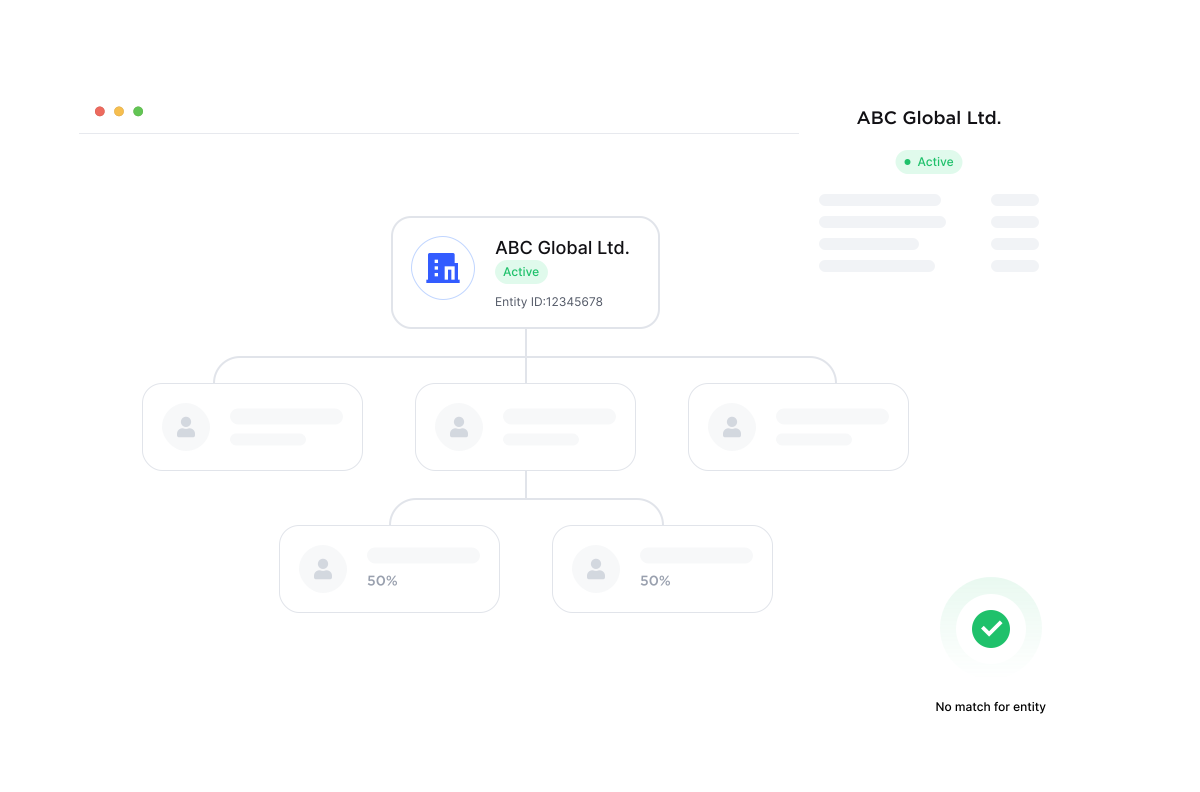
01 · Business onboarding
Understand the business and its ownership
WIDTH KYB brings company, ownership and screening information into the business-onboarding workflow. The illustration shows an example entity and the relationships around it.
- Review the business and relevant ownership context.
- Keep supporting information available for review.
- Carry unresolved questions into the appropriate workflow.
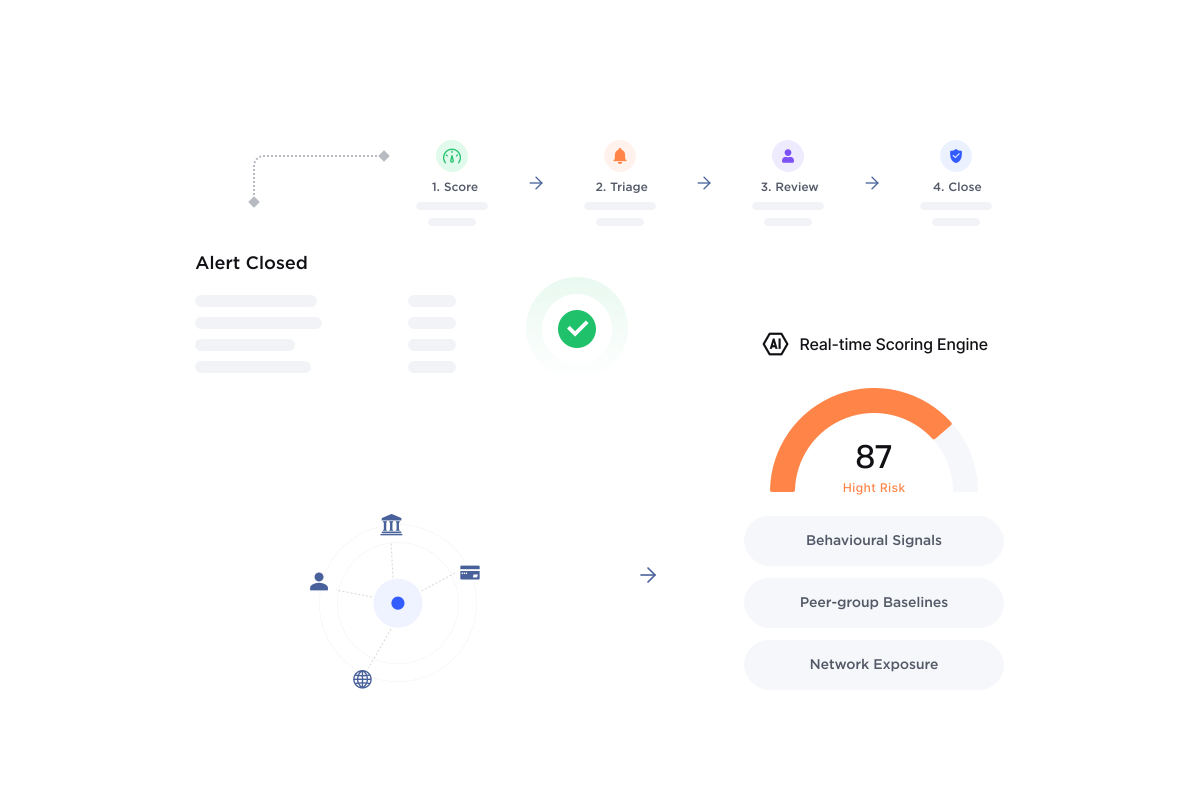
02 · Ongoing monitoring
Connect the activity with the alert review
WIDTH Transaction Monitoring brings activity and relevant customer context into alert review. The illustration presents scoring, triage, review and closure as a connected workflow.
- Examine activity and relevant risk signals.
- Review the alert with the available context.
- Connect the investigation and the recorded outcome.
Evaluate payment compliance software in Malaysia
- Which regulatory category and service does this workflow represent, and which policies need to be mapped?
- Can the team reconcile source events with records actually received by monitoring?
- Can evidence be handed from onboarding to investigation without losing the source or review history?
- What hosting location, access controls, retention, outsourcing and cross-border data arrangements would apply?
- How will changes to rules, integrations and permissions be tested and approved before use?
Payment compliance questions
Does one configuration cover MSBs and e-money issuers?
Do not assume so. Define the entity, service and applicable policies, then test the customer and payment journeys separately.
Is the 2026 payment-services technology policy already effective?
BNM’s published policy states an effective date of 12 March 2027. Distinguish preparation for that date from obligations already applicable to the institution, and check for subsequent updates.
Does using WIDTH mean BNM compliance is guaranteed?
No. The institution remains responsible for its applicable obligations, governance and decisions. Product capability, integration and deployment arrangements must be evaluated for the actual use case.
What needs confirming before a Malaysia deployment?
Confirm the proposed hosting location, data flows, access, retention and contractual arrangements with WIDTH. Malaysian data residency, regulatory recognition and particular local payment connections require separate verification.
What should an MSB or e-money team bring to the demo?
Bring a synthetic customer journey, an example event structure and a case requiring escalation. Include your required source formats, language needs, record exports and deployment constraints.
WIDTH
Bring the Malaysian workflow into view
Test a representative MSB or e-money journey, including a missing-data case and an escalation. Agree the evidence, integration scope and reviewer responsibilities before implementation.
Bring to the demo
- A representative customer journey
- A sample event structure
- A case with unresolved questions
Sources and scope
Regulatory sources checked on 12 November 2026. Applicability depends on the entity and service. Scenarios are illustrative evaluation examples, not customer results. Confirm deployment-specific capabilities with WIDTH.