
Trusted by 500+ institutions across 180 jurisdictions





Three Things That Make KYC Pass an Audit
One API, Every Check
Liveness, document OCR, NFC chip read and sanctions and PEP screening in one call. No vendor stitching, no re-keying.
Audit Trail by Construction
Every decision ships with its inputs, the rule that fired and the policy version, meeting Wolfsberg AML Principles by default.
See AML Monitoring →Re-KYC on Risk, Not Calendar
Sanctions updates, address changes and behavioural anomalies trigger re-verification, so static one, three and five-year cycles can retire.
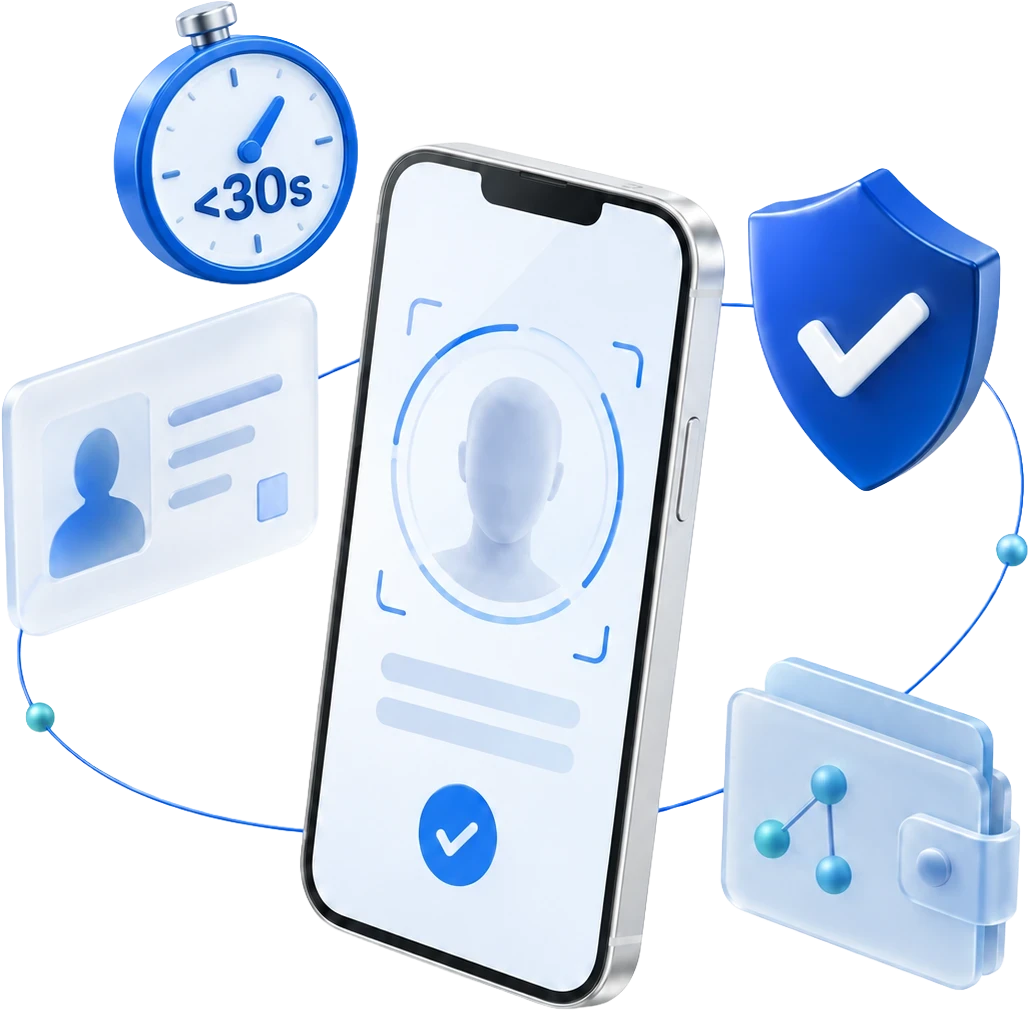
- <30sDecision timeFrom selfie and ID upload to a decision
- 98.2%Face-match accuracyNIST FRVT-ranked liveness
- 16,000+ID document typesFrom 254 jurisdictions
Verify More Than the Document Image
Document capture, data extraction and authenticity checks run in the same KYC workflow as screening and review, without separate tools
- 01Capture ClearlyGuide applicants to a usable image and check its quality before the document enters review
- 02Extract and Cross-CheckRead visual, MRZ, barcode and chip data, then compare the fields across every available source
- 03Return an Auditable ResultConnect the evidence to screening, risk decisions, cases and the wider WIDTH audit trail





Common Questions About KYC Onboarding
How fast is the WIDTH KYC verification flow?
Most retail KYC decisions return in under 30 seconds end to end, including biometric liveness, document OCR and sanctions and PEP screening. The screening call is typically sub-second, document OCR takes about 4 to 8 seconds and passive liveness is sub-second.
Which identity document types and regions are supported?
WIDTH verifies more than 16,000 identity document types from 254 jurisdictions: passports, national IDs, driving licences, residence permits and local documents such as the Singapore NRIC, HKID, MyKad, Aadhaar and Emirates ID, with MRZ, barcode and chip extraction where available.
Is the KYC flow FATF Rec 10 and MAS Notice 626 compliant?
Yes. The default workflow covers FATF Recommendation 10 on customer due diligence and is configured for MAS Notice 626, the HKMA AML/CFT Guideline, FCA SYSC 6.3 and FINTRAC rules. Each decision is kept as a versioned record with its source evidence and screening hits.
Which biometric liveness options does WIDTH use?
WIDTH supports passive liveness with no user action, active challenge-response liveness and 1:1 face match against the document portrait. Liveness providers are pluggable: deployments commonly use iProov, FaceTec or the WIDTH model, chosen per region and risk policy.
How does WIDTH handle re-KYC and periodic refresh?
Re-KYC can be triggered by events, such as a sanctions list update, a change of residence or a transaction anomaly, or by a calendar cycle. WIDTH keeps the signed identity record and re-collects only the fields that changed, which keeps drop-off low.
Can the SDK be embedded in our own onboarding flow?
Yes. WIDTH provides Web, Android and iOS SDKs that fit into any onboarding stack. The SDK collects biometrics and documents on the device and returns one decision token your backend verifies through the REST API, with no third-party iframes.
KYC Decisions in 30 Seconds, Fully Auditable
A 30-minute call with a live applicant and a full FATF Rec 10 audit export at the end