Hong Kong · MSO and stored-value workflows
Payment Compliance Software in Hong Kong
Keep customer due diligence, payment activity and case evidence connected. Evaluate WIDTH against your Hong Kong business model and the review responsibilities your team actually carries.
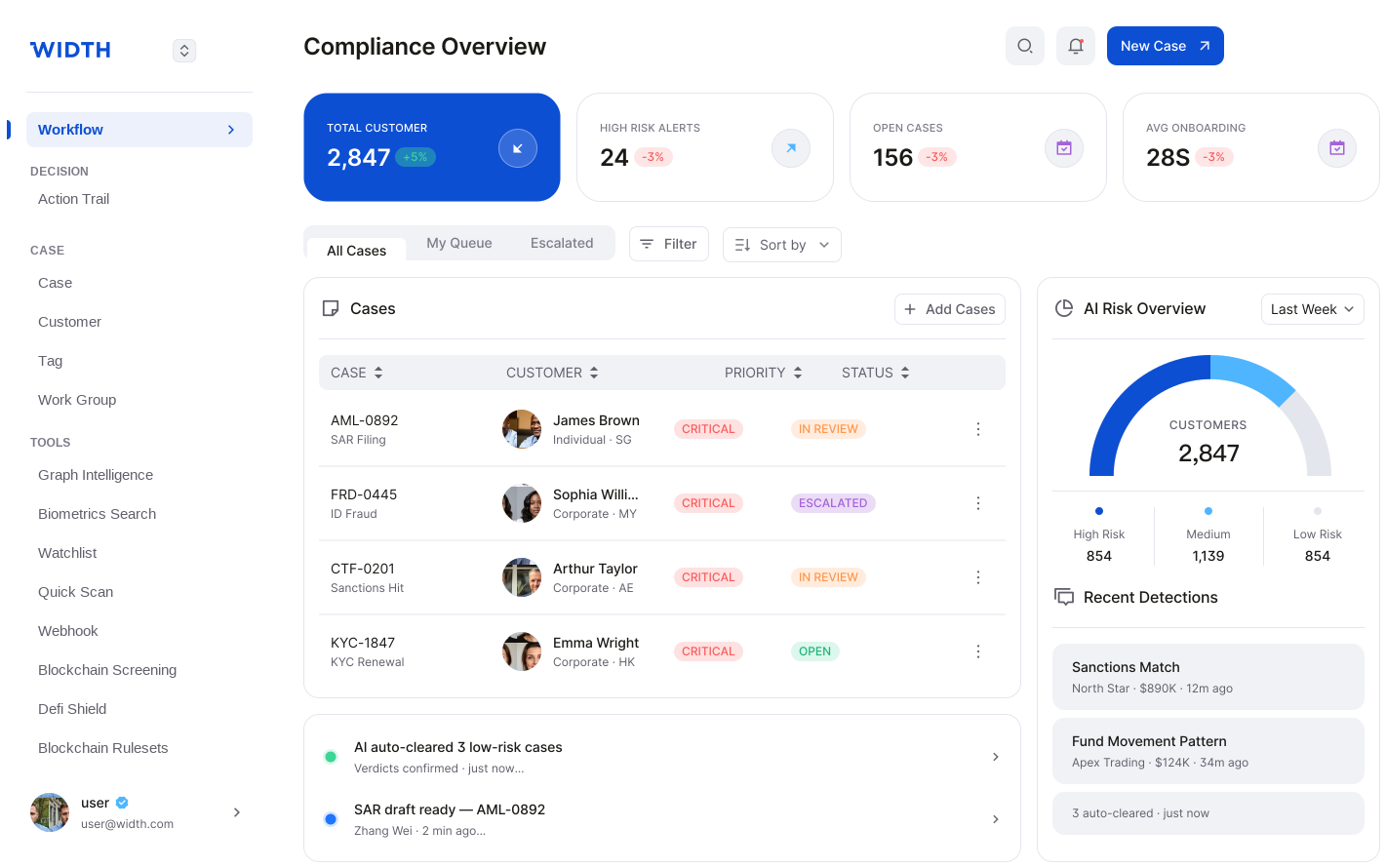
Payment compliance software for Hong Kong payment businesses connects customer due diligence, business verification, screening, transaction monitoring and case management. WIDTH brings onboarding, activity and investigation context into one workflow. An MSO and an SVF licensee should assess that workflow against their own supervisory framework, data and approval responsibilities.
Choose the right business-model lens
The first question is which service the organisation provides. A shared software platform does not make different regulatory categories interchangeable.
Money service operators
For remittance and money-changing journeys, test how the customer relationship and the purpose of a transaction remain available during review.
Stored-value facilities
For a stored-value journey, examine how customer context follows relevant wallet activity and an investigation.
Corporate payment relationships
For business customers, follow the ownership and control evidence, relevant counterparties and unresolved questions through the case.
Separate MSO and stored-value requirements
Hong Kong Customs and Excise supervises money service operators, including remittance and money-changing businesses. Its published material describes the relevant MSO licensing, customer due diligence and record-keeping context.
The Hong Kong Monetary Authority (HKMA) is responsible for licensing and supervising stored-value facilities and overseeing designated retail payment systems. Review the HKMA’s stored-value-facility framework when that is your business model. Confirm that the category matches the actual service before selecting controls.
MSO and SVF: choose the right starting point
The business model determines the regulatory lens. The comparison below is a starting point for software evaluation, not a complete statement of obligations or a licensing assessment.
| Evaluation point | Money service operator (MSO) | Stored-value facility (SVF) |
|---|---|---|
| Service context | Remittance and money-changing services. | Stored-value services, such as a relevant wallet or prepaid-value journey. |
| Supervisory context | Hong Kong Customs and Excise Department. | Hong Kong Monetary Authority (HKMA). |
| Customer-to-activity journey | Connect the customer and, for a business, its ownership and authorised representatives to the remittance and relevant payment parties. | Connect customer due diligence to the relevant stored-value activity and subsequent investigations. |
| Demo evidence | A customer file, remittance-party data, screening outcome, review notes and a documented decision. | A customer file, representative activity history, a review trigger and the resulting investigation record. |
| Control design | Agree the service, data fields, applicable policy, escalation owners and review evidence. | Agree these separately for the SVF business; do not inherit an MSO configuration without assessment. |
See the Customs MSO framework and HKMA SVF framework. Groups with several services should map each activity before deciding which controls can be shared.
A worked Hong Kong corporate remittance review
Illustrative evaluation case: a Hong Kong trading business requests an HKD 180,000 supplier payment. The beneficiary name differs from the supplier named on the invoice. This inconsistency creates a question to resolve; the amount and name difference do not establish suspicion or a legal threshold.
1. Establish what is known
Keep the company name, BRN, business description, ownership evidence and authorised-person information together. Link the payment amount, currency, beneficiary and stated purpose to the customer. Record the source and date of each supporting item so later reviewers can distinguish verified information from assertions.
2. Investigate the mismatch
Compare the invoice with the beneficiary details and request an explanation for the different name. A documented collecting-agent relationship could explain it; an unsupported explanation leaves an evidence gap. Review relevant previous activity and screening results without treating a similar name as a confirmed identity.
3. Record a reasoned outcome
If evidence resolves the question, record what established the relationship and who approved the outcome. If it remains unresolved, document the missing evidence and route the case under the institution’s procedures. A payment action, case closure and reporting decision are separate decisions with their own authority.
A useful demonstration should show both a resolved case and one with missing information. Success means the next reviewer can reconstruct the decision from the record, not simply see a risk score or a closed alert.
One platform. A connected payment review.
WIDTH is an All-in-One Compliance and Risk Decision Intelligence Platform. It connects onboarding, monitoring and investigations around one platform, one workflow and one source of truth.
Customer and business context
Bring KYC, KYB and relevant customer information into the review.
Explore KYC onboarding →Activity and relationship context
Evaluate transaction monitoring alongside the customer and relevant relationships.
Explore transaction monitoring →Evidence and authorised review
Keep evidence, investigation work and reviewer decisions connected.
Explore case management →For business ownership evidence, explore KYB onboarding and Graph Intelligence.
KYB and monitoring for a Hong Kong review
Keep the business identity, ownership evidence and payment purpose connected. The product illustrations are paired here with Hong Kong review questions and a clearly labelled HKD example.
Remittance and money-changing review context.
Stored-value-facility review context.
Select the framework that applies to the actual service. Confirm available data sources and integrations with WIDTH.
01 · Hong Kong business onboarding
Review a Hong Kong business and its owners
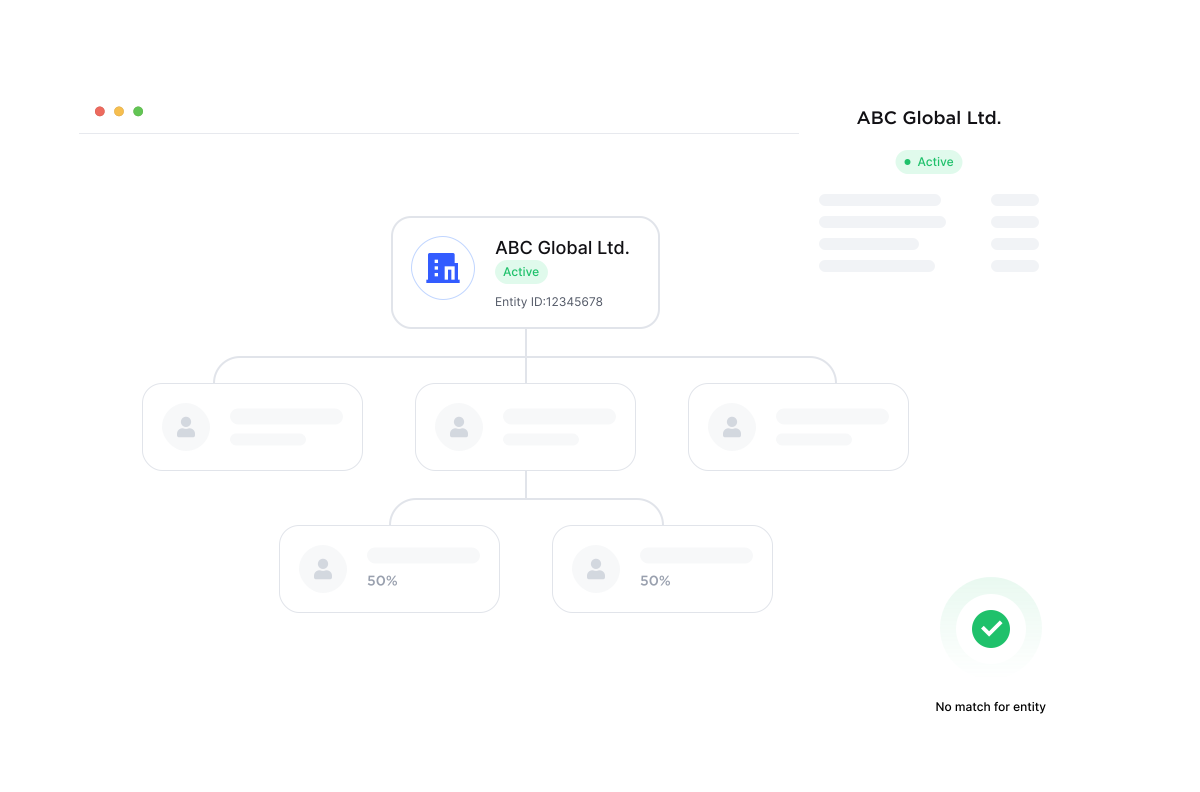
Bring the company identity, ownership information and screening evidence into the KYB review. For a Hong Kong corporate customer, reconcile the company name and Business Registration Number (BRN) with supporting records, then examine who owns, controls and acts for the business.
Illustrative Hong Kong review
- Customer
- Hong Kong corporate payment customer — illustrative.
- Records
- Company name, BRN and supporting business-registration information.
- Review point
- Ownership and control evidence, plus the person authorised to act for the company.
The Companies Registry uses BRN as the key number for company identification. Registry access or an automated lookup is not assumed.
Local reference points: Companies Registry · IRD
Explore KYB onboarding →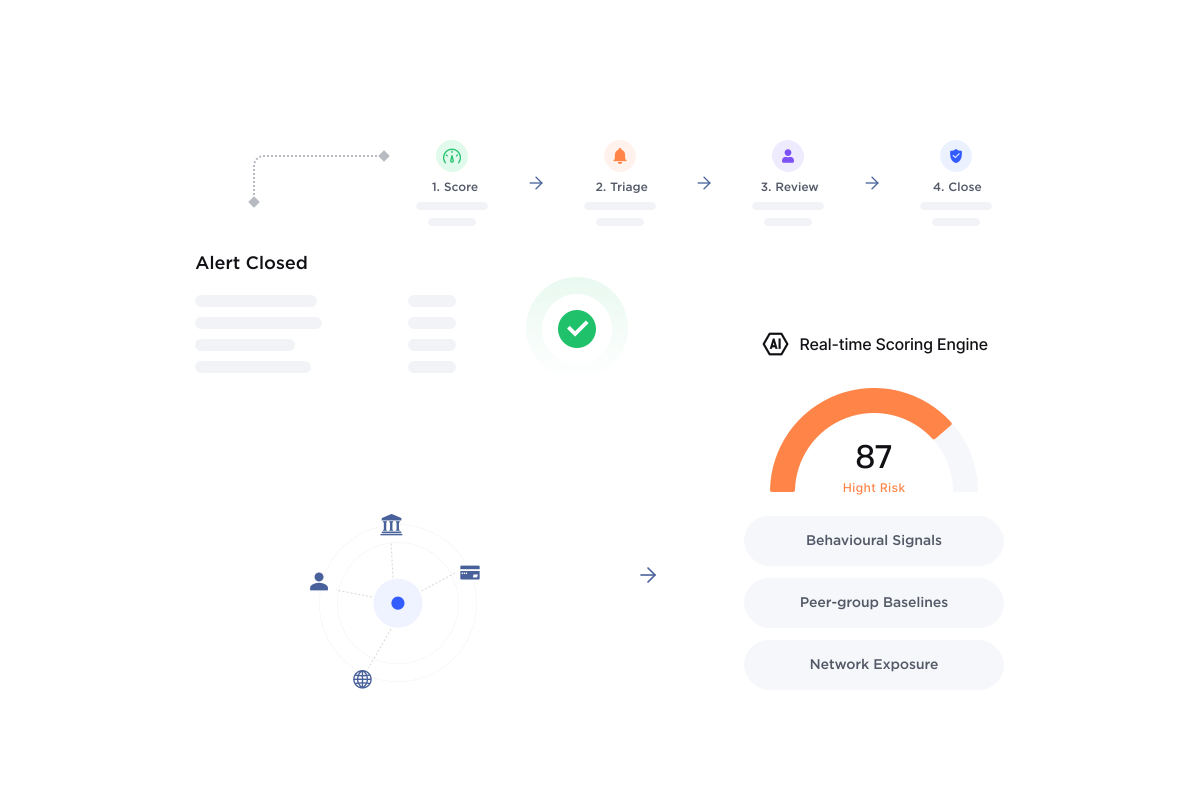
02 · Hong Kong payment review
Review an HKD payment in its business context
Follow an illustrative corporate remittance from the customer profile to the beneficiary and supporting explanation. Ask whether the payment fits the stated business purpose, what evidence is missing and who should review an unresolved question.
Illustrative Hong Kong review
- Payment
- HKD 180,000 cross-border supplier payment — illustrative.
- Review question
- Is the beneficiary relationship consistent with the stated payment purpose?
- Evidence and outcome
- Review beneficiary details and supporting documents; record the rationale or escalate to an authorised reviewer.
HKD 180,000 is an example amount, not a legal reporting threshold, a configured alert threshold or evidence of wrongdoing.
Connect the controls across the customer lifecycle
A useful payment-compliance workflow preserves the reason for a decision. An onboarding result should remain available when payment behaviour changes, and an investigation should show which evidence supported the final outcome.
KYC and KYB establish the starting context
Identify the customer and understand the relationship. For a corporate customer, distinguish the company identity, ownership and control, and authority to act. A BRN or a registration document is useful evidence of identity; it does not by itself resolve every ownership or customer-risk question.
Screening and monitoring answer different questions
Screening examines parties against the selected lists and risk information. Monitoring examines activity in context and over time. A possible name match needs identity review; an unusual payment pattern needs an explanation of behaviour. Neither signal alone proves wrongdoing.
Case management preserves the reasoning
An investigator needs the trigger, relevant customer and activity records, supporting documents, unresolved questions and prior review history. WIDTH case management brings these records and reviewer decisions together. The case should explain why it was closed or escalated.
For MSO remittances, the Customs FAQs explain that relevant-party screening extends beyond the sender and recipient to relevant institutions and named parties in the payment message. Use this to check field coverage rather than assuming two name fields are sufficient. Read Customs FAQ Q24.
What to establish before implementation
Use these workstreams to turn a software demonstration into a defined operating scope. They are evaluation criteria, not a claim that every field, connector or deployment option is included in every WIDTH contract.
Data and event coverage
Map customer identifiers, corporate relationships, payment parties, currencies, timestamps and the identifiers needed to join events to a case. Test missing fields, duplicates, corrected events and delayed delivery. Agree how exceptions are detected and resolved; a convincing screen cannot compensate for incomplete source data.
Policy, testing and governance
Agree which controls run at onboarding, at a payment event or during ongoing review. Use representative synthetic cases with expected outcomes, including false matches and missing evidence. Assign owners for configuration changes, testing and review. Customs FAQ Q23 discusses independent validation of MSO transaction-monitoring systems and processes.
People, evidence and deployment
Define queues, reviewer permissions, escalation and sign-off. Test retrieval of the evidence and decision history. Confirm interface, document and export language support separately, including Traditional Chinese and English needs. Agree hosting, access, retention, integration effort and commercial scope directly with WIDTH.
Customs FAQ Q22 also makes clear that using an intermediary for specified CDD measures does not transfer the MSO’s ongoing-monitoring responsibility. Software and service providers support the work; the institution must retain clear accountability.
Evaluate payment compliance software in Hong Kong
- Customer continuity: demonstrate how a business record and its ownership evidence remain available in a later payment case.
- Signal explanation: distinguish a screening match from an activity trigger, showing the information behind each.
- Evidence handling: add a document, record a disputed relationship and retrieve the history without losing the original context.
- Authorised decisions: show assignment, escalation, reviewer rationale and sign-off; identify any action that requires a separate approval.
- Deployment scope: document the agreed data sources, language support, integration responsibilities and exclusions before committing.
Payment compliance questions
What should Hong Kong payment compliance software cover?
It should support the institution’s customer checks, relevant screening, activity review and investigation process, with evidence and responsibility connected across the workflow. The exact controls depend on the service and applicable framework. Evaluate an MSO and an SVF journey separately rather than treating “Hong Kong compliance” as one universal configuration.
Is business registration enough for KYB?
No. Registration information helps establish the business identity, but the review also needs to address ownership, control, authority to act and the intended relationship as applicable. Keep the source evidence and open questions visible. A retrieved company record should not be presented as a complete customer-risk assessment.
How is transaction monitoring different from sanctions screening?
Screening examines relevant names and identifiers against selected lists or risk information. Transaction monitoring examines activity, patterns and changes in the customer’s context. They need different inputs and review paths. A screening result may feed an investigation, but monitoring does not replace relevant-party screening.
Does using software satisfy an MSO’s obligations?
Buying software does not establish compliance or transfer the institution’s responsibilities. The operating model must cover relevant data, configured controls, testing, ongoing review and authorised decisions. Customs addresses ongoing-monitoring responsibility and independent system validation in its MSO FAQs Q22 and Q23.
Can WIDTH connect KYB with payment investigations?
WIDTH connects business information, relationships and investigation evidence across onboarding and case review. A Hong Kong payment case can therefore be evaluated with the original business context in view. Confirm the actual registry feeds, event connections, permissions and evidence available in your proposed deployment rather than assuming every integration is included.
What evidence should an alert review retain?
A useful review record identifies the trigger, relevant customer and payment information, supporting documents, checks performed, unresolved questions, reviewer reasoning and authorised outcome. Agree the precise record format, access and retention arrangements against your policy and applicable requirements; this list is a practical evaluation aid.
Can the workflow support Traditional Chinese and English?
Include both languages in the acceptance tests: interface labels, name searches, source documents, reviewer notes and exports can have different support. Use representative synthetic names and mixed-language documents. The availability and scope of each capability must be confirmed with WIDTH.
How should we compare vendors?
Ask each vendor to run the same synthetic customer journey and unresolved case. Compare context continuity, explanation of signals, evidence retrieval, reviewer control and implementation scope. Request evidence for numerical performance claims and clarify the baseline, dataset and deployment conditions. A generic feature checklist cannot demonstrate these differences.
WIDTH
Make the Hong Kong demo specific
Bring an MSO or stored-value journey and an unresolved case. Follow the customer, payment context and evidence through to the authorised outcome.
Bring to the demo
- A representative customer journey
- A sample event structure
- A case with unresolved questions
Sources and scope
Regulatory and WIDTH source pages reviewed on 13 November 2026. This is a software-evaluation guide, not a complete regulatory checklist. Applicability depends on the entity and service. Cases are illustrative, not customer results. Confirm deployment-specific capabilities with WIDTH.
- Hong Kong Customs — supervision of money service operators
- HKMA — stored-value facilities and retail payment systems
- Companies Registry — electronic search and BRN identification
- Inland Revenue Department — business registration
- Hong Kong Customs — MSO FAQs Q22–Q24
- WIDTH platform and case-management information