Singapore · Payment institutions
Payment Compliance Software in Singapore
Connect customer onboarding, payment risk and investigations in one workflow. Evaluate WIDTH for the decisions your Singapore payment business needs to explain and control.
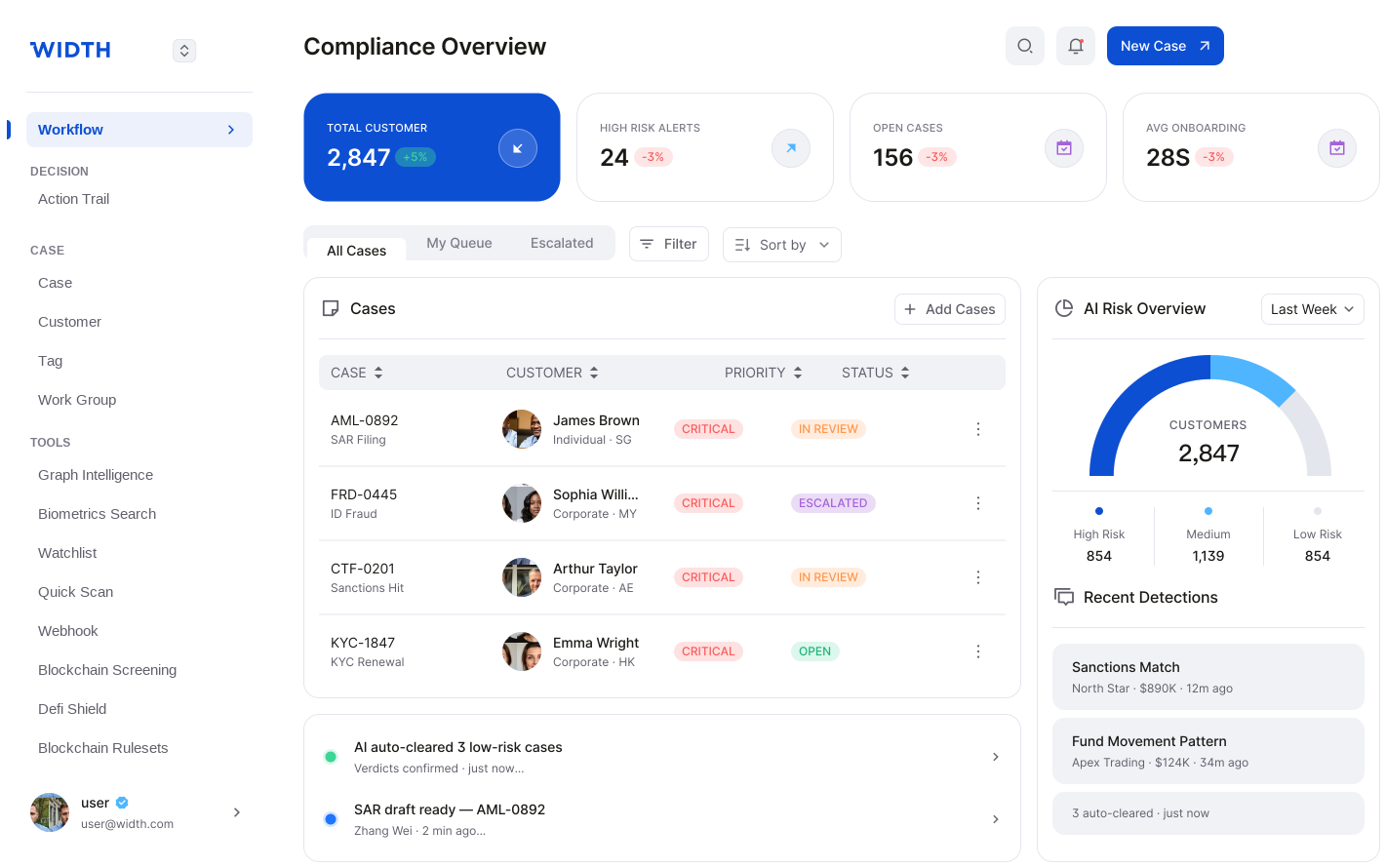
Payment compliance software helps a payment institution connect customer checks, screening, transaction monitoring and investigations. For a Singapore deployment, start with the services you provide, the applicable MAS framework and the evidence your reviewers need.
Built around your payment service
A remittance flow and a merchant-acquiring journey do not create the same review questions. Start the demo with the service and customer relationship you actually manage.
Cross-border money transfers
Follow the customer, originator, beneficiary and relevant corridor context through a payment review.
Merchant-facing payment services
Connect business verification, beneficial ownership and the purpose of the merchant relationship to subsequent activity.
Account and wallet journeys
Keep onboarding information usable when behaviour changes, funds move to new counterparties or a review needs escalation.
Start with the applicable MAS framework
The Monetary Authority of Singapore (MAS) distinguishes payment-service licence categories, including Standard Payment Institutions and Major Payment Institutions. The scope of your services determines which requirements need to be assessed. Use the MAS payments regulations and guidance as the starting point.
MAS Notice PSN01 addresses AML/CFT for specified payment services. A software evaluation should connect the applicable policy to customer due diligence, monitoring, escalation and retained evidence. It should not treat buying software as a licence approval or an assurance of compliance.
Test a changing cross-border customer
Illustrative demo scenario: a business customer begins paying a new set of overseas beneficiaries. This is a test journey, not a WIDTH customer result or evidence of wrongdoing.
Bring the customer context
Retrieve the business profile, ownership information, relationship purpose and expected activity.
Examine the change
Compare the new counterparties and activity with the available customer and payment context.
Resolve the open questions
Collect supporting information, record uncertainties and assign the review to an authorised person.
Keep the decision connected
Retain the reasoning, approval and follow-up with the case. Distinguish any payment action from a reporting decision.
One platform. A connected payment review.
WIDTH is an All-in-One Compliance and Risk Decision Intelligence Platform. It connects onboarding, monitoring and investigations around one platform, one workflow and one source of truth.
Customer and business context
Bring KYC, KYB and relevant customer information into the review.
Explore KYC onboarding →Activity and relationship context
Evaluate transaction monitoring alongside the customer and relevant relationships.
Explore transaction monitoring →Evidence and authorised review
Keep evidence, investigation work and reviewer decisions connected.
Explore case management →For business ownership evidence, explore KYB onboarding and Graph Intelligence.
See KYB and transaction monitoring in context
Start with the business behind the relationship, then follow its payment activity. These existing WIDTH product illustrations show two connected parts of the compliance workflow.
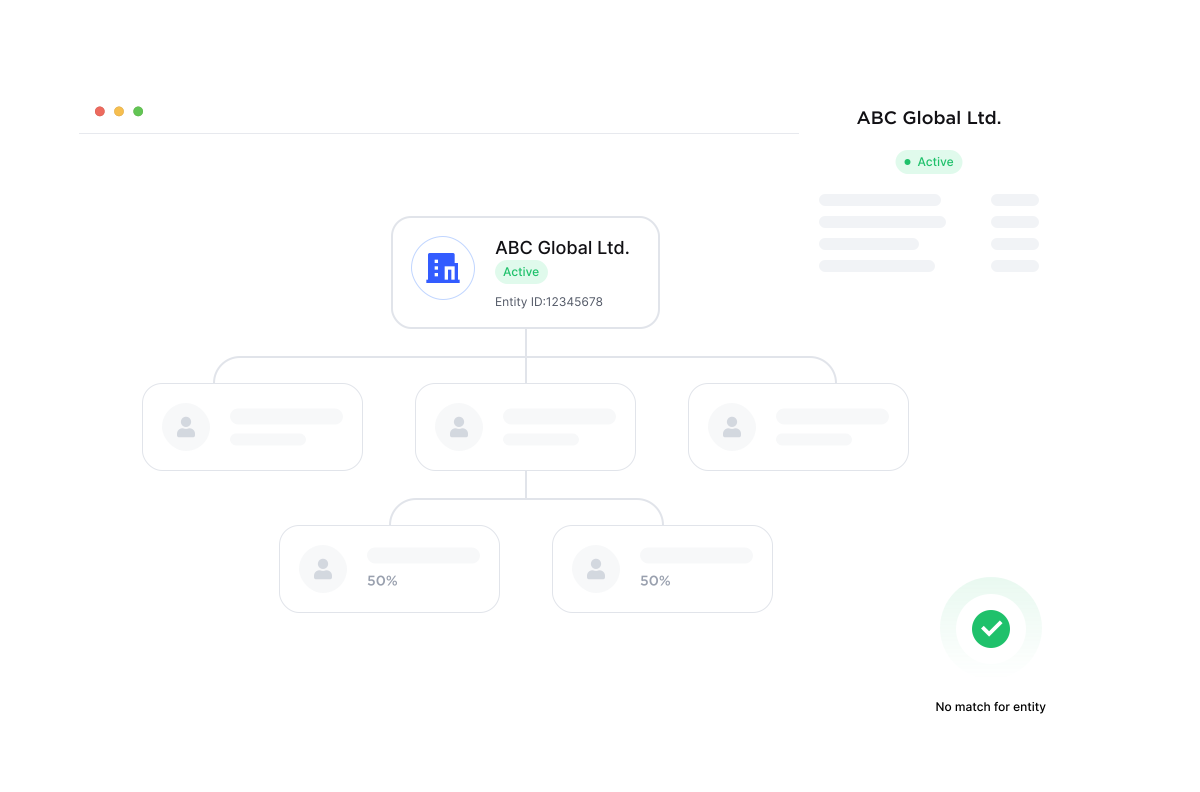
01 · Business onboarding
Understand the business and its ownership
WIDTH KYB brings company, ownership and screening information into the business-onboarding workflow. The illustration shows an example entity and the relationships around it.
- Review the business and relevant ownership context.
- Keep supporting information available for review.
- Carry unresolved questions into the appropriate workflow.
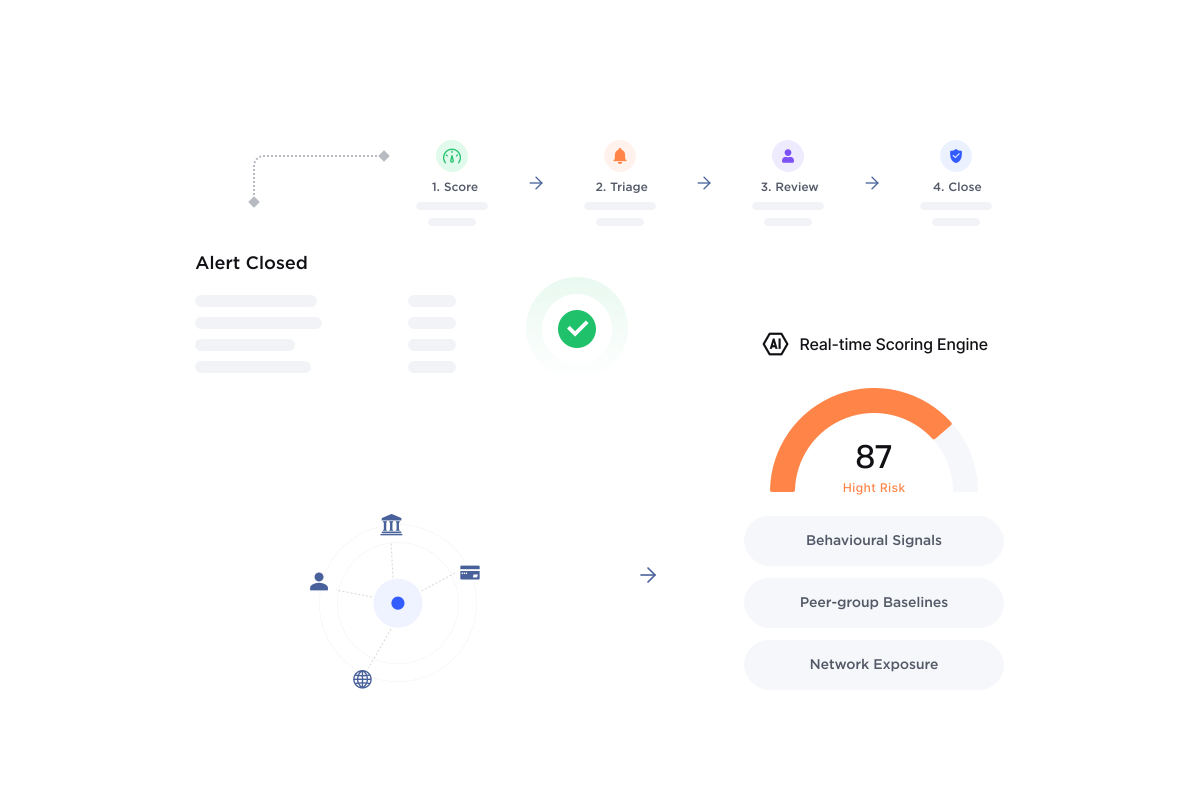
02 · Ongoing monitoring
Connect the activity with the alert review
WIDTH Transaction Monitoring brings activity and relevant customer context into alert review. The illustration presents scoring, triage, review and closure as a connected workflow.
- Examine activity and relevant risk signals.
- Review the alert with the available context.
- Connect the investigation and the recorded outcome.
Evaluate payment compliance software in Singapore
- Which source events and payment fields will reach the workflow, and how will missing records be surfaced?
- Can a reviewer retrieve KYC or KYB information without rebuilding the customer story?
- Can the team distinguish a screening match, a transaction pattern and an unresolved evidence gap?
- Which outcomes are recommendations, referrals or permitted payment actions—and who authorises each?
- What evidence can be retrieved for internal review, and how will retention and access be configured?
Payment compliance questions
Does WIDTH replace the payment institution’s compliance team?
No. WIDTH supports connected compliance work. Your institution retains responsibility for its applicable obligations, policies, reporting decisions and authorised approvals.
Is one software configuration suitable for every Singapore payment service?
No single configuration should be assumed to fit every business. Agree the service scope, customer types, payment data, review process and applicable requirements before implementation.
How does payment screening differ from transaction monitoring?
Screening examines relevant parties or payment information against selected risk criteria. Monitoring examines activity and patterns over time. Their timing, inputs and permitted actions should be defined separately.
Can the workflow connect business onboarding with later alerts?
WIDTH’s platform connects onboarding, monitoring and investigations. Use a business-customer demo to establish which KYB records, payment events and case evidence will be available in your deployment.
What should we bring to the demo?
Bring a representative business-customer journey, a sample payment-event structure and one escalation scenario, using synthetic or appropriately anonymised information.
WIDTH
Bring your Singapore payment workflow
Follow one customer from onboarding through a changed payment pattern and a reasoned review. Agree the data, control timing and responsibilities for your proposed deployment.
Bring to the demo
- A representative customer journey
- A sample event structure
- A case with unresolved questions
Sources and scope
Regulatory sources checked on 12 November 2026. Applicability depends on the entity and service. Scenarios are illustrative evaluation examples, not customer results. Confirm deployment-specific capabilities with WIDTH.