From Alert to Signed-Off Decision, in One Case File

Investigations slow down when analysts must find the customer, the transactions and the earlier cases before they can begin. WIDTH opens each case with the evidence already in place, keeps ownership and escalation clear, and records how every decision was reached.

AML case management, from alert to sign-off

Built for investigators, MLROs and financial crime operations teams in regulated businesses

AI Reviewer figures come from WIDTH product documentation. A reviewer approves every disposition.

What is AML Case Management?

AML case management is the software and process used to investigate alerts, gather evidence and reach a documented decision, such as closing the case or filing a suspicious transaction report. WIDTH Case Management opens each case with the evidence attached and records six stages, from opened to signed off. AI Reviewer prepares Level-1 reviews in under 2 minutes.

Recorded stages per case
6 (opened, assigned, evidenced, reviewed, escalated, signed off)
Level-1 review
under 2 minutes per alert decision with AI Reviewer
Explainability
100% of AI Reviewer decisions explainable and audit-ready
Narratives and reports
drafted in 16+ languages, including non-Latin scripts
Audit trail
append-only and exportable
Filing
the decision to file a SAR or STR, and the filing itself, stay with your organisation
The Investigation Starts by Assembling Evidence

Before an analyst can judge a case, they rebuild the customer's history, look up screening results, export transactions and search old emails for what was decided last time. The judgement takes minutes. The preparation takes hours.

When cases live in spreadsheets and inboxes, ownership blurs, escalations stall and the reasoning behind a decision is hard to find when an examiner asks. WIDTH keeps the whole investigation in one workflow, connected to the customer.

Hours of Preparation

Level-1 review is slow and costly because the evidence sits in several systems.

Unclear Ownership

Cases wait in shared inboxes with no owner, no SLA and no visible next step.

Reasoning That Disappears

Reviewer notes and sign-offs live where the next reviewer, or the regulator, can't find them.

Who It's For

  • Financial crime investigators
  • MLROs and compliance officers
  • Fraud and AML operations leads
  • Teams at banks, payment firms, fintechs, digital asset businesses, insurers and DNFBPs

Problems It Solves

  • Evidence spread across systems
  • Level-1 backlogs
  • Unowned and overdue cases
  • Narratives written from scratch
  • Sign-offs buried in email

Where It Fits

Investigate, Decide and record. Receives cases from Onboarding, AML Monitoring, Fraud Detection and KYT, with their context attached.

How It Fits Your Stack

  • The WIDTH dashboard for investigators
  • REST API and webhooks to open cases from your own systems
  • Exports for audit and reporting

Which one do I need?

Case Management is where investigations live. AI Reviewer prepares Level-1 reviews inside it. Use Case Management alone, or add AI Reviewer to clear the queue faster.

What You Get

Cases That Open with the Evidence

Problem
Every investigation starts from an empty file.
What WIDTH does
Opens the case from the alert, screening hit or concern that raised it, and attaches the customer profile, transactions, connected entities and earlier cases.
Result
Analysts spend their time reviewing risk, not gathering it.

Clear Ownership and Escalation

Problem
Cases stall when nobody owns the next step.
What WIDTH does
Assigns every case an owner and a queue, orders work by risk and urgency, tracks internal SLAs and escalates to senior review when your policy requires it.
Result
Leaders see what is open, what is late and who holds it.

AI Drafts, Investigators Approve

Problem
Writing the narrative takes as long as the investigation.
What WIDTH does
AI Reviewer prepares a Level-1 review in under 2 minutes and drafts the narrative from the case evidence, in 16+ languages. Investigators review every line, edit it and approve it.
Result
Faster reviews, with the reasoning still owned by people.

Ready for SAR, STR and MLRO Review

Problem
Reporting means rebuilding the case at the end.
What WIDTH does
Keeps the evidence, narrative and decision history organised from the start, and compiles network findings from Graph Intelligence into a report with recommended actions.
Result
The MLRO reviews a complete file, not a collection of emails.

See the Case, the Network and the Decision Trail Together

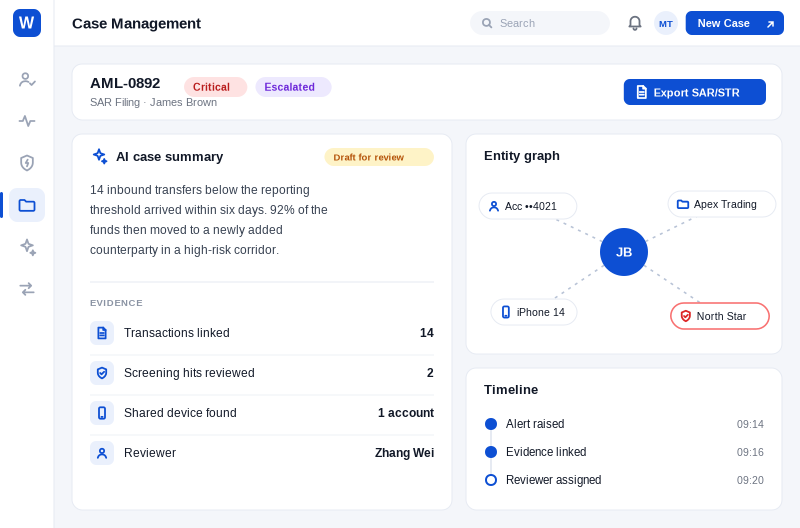
One case file holds the trigger, the evidence, the connected parties, the draft narrative and every action taken.

  • Evidence AttachedCustomer, transactions, documents and earlier cases.
  • Network in ViewThe patterns Graph Intelligence found, with every link cited.
  • Sign-Off on RecordWho approved what, and when.

How It Works

  1. OpenRaise a case from a monitoring alert, a screening result, a fraud event or a manual concern, and route it to the right queue.
  2. AssembleCustomer information, activity, connected entities and case history are attached before the analyst begins.
  3. InvestigateExamine the activity and relationships, and add notes and documents as the work proceeds.
  4. DraftAI Reviewer prepares the review and a draft narrative. The investigator reviews, edits and approves it.
  5. EscalateSend higher-risk cases and reporting decisions to senior review or the MLRO, with the evidence and history attached.
  6. Sign OffRecord the outcome, the approver and the evidence considered, ready for the next review.

Decisions Stay with Your Team

WIDTH organises the evidence, drafts the narrative and recommends actions. Investigators decide, MLROs sign off, and every approval is recorded. Reporting requirements and submission processes vary by jurisdiction and institution: WIDTH supports the workflow, and the decision to file a SAR or STR, and the filing itself, remain your organisation's responsibility.

Every Decision Traceable, Long After the Case Closes

An examiner may ask about a case years later. WIDTH keeps the full story in six recorded stages, in an append-only audit trail you can export.

StageWhat is Recorded
OpenedWhat raised the case, when, and from which risk signal
AssignedThe owner, the queue and each reviewer along the way
EvidencedWhat evidence was considered and attached, and when
ReviewedEach reviewer's conclusion and recorded rationale, including edits to AI drafts
EscalatedWhether the case was escalated, to whom, and what the senior review found
Signed offWho approved the outcome, what changed during the investigation, and when it closed
AI assistance
Every AI disposition carries an evidence-linked, human-readable rationale. Changes to AI drafts are recorded, so the reasoning behind the final wording is clear.

Trusted by Regulated Institutions Since 2014

500+regulated institutions*
180+jurisdictions*
ISO/IEC 27001certified
ISO/IEC 27701certified

*Cumulative since 2014.

Before You Get Started

What is AML case management?

AML case management is how a regulated firm investigates an alert or concern and records the outcome: opening a case, attaching evidence, assigning an owner, escalating and signing off the decision. Good case management lets a regulator follow the reasoning years later. WIDTH Case Management opens each case with the evidence attached and records six stages, from opened to signed off.

What is the difference between an STR and a SAR?

An STR (suspicious transaction report) and a SAR (suspicious activity report) are the same kind of report under different names: a report to the financial intelligence unit when a firm suspects money laundering or terrorism financing. Singapore and Hong Kong use STR; the United States and the United Kingdom use SAR. Content and deadlines vary by jurisdiction. WIDTH drafts the narrative, and the decision to file stays with you.

What audit trail do regulators expect for a compliance decision?

Regulators generally expect a firm to show how each decision was reached: what raised the case, what evidence was considered, who reviewed and approved it, and when. Record-keeping periods and formats are set by local rules. WIDTH keeps six recorded stages per case, from opened to signed off, in an append-only audit trail that can be exported for examiners and internal audit.

Where do cases come from in WIDTH?

WIDTH cases come from monitoring alerts, screening results, fraud events, onboarding exceptions, KYT hits or a manual concern. Each one arrives with its context attached, including the customer profile, transactions, connected entities and earlier cases. Cases can also be opened from your own systems through the REST API.

Can we set our own queues, SLAs and escalation rules?

Yes. In WIDTH Case Management, queues, priorities, internal deadlines, review stages and approval steps follow your policy, and leaders can see what is open, what is late and who holds it. Escalations to senior review or the MLRO happen when your policy requires them.

How does AML case management help with audits?

Every WIDTH case keeps six recorded stages, from opened to signed off, with evidence, rationale and approvals in an append-only audit trail you can export. Edits to AI drafts are recorded too, so the reasoning behind the final wording is clear.

Who is Case Management built for?

WIDTH Case Management is built for investigators, MLROs and financial crime operations teams in regulated businesses, including banks, payment firms, fintechs, digital asset businesses, insurers and DNFBPs. It suits teams that need one place to run investigations, escalate and sign off with a record an examiner can follow.

Can WIDTH file SARs or STRs?

No, WIDTH does not file reports for you. WIDTH organises the evidence and drafts the narrative and recommended actions. The decision to file, and the submission to your financial intelligence unit, remain with your organisation. Reporting requirements vary by jurisdiction and institution.

Does AI make the case decision?

No. AI Reviewer prepares the review, drafts the narrative and recommends a disposition. Investigators review, edit and approve, and MLROs sign off where your policy requires it. Every approval is recorded against the person who made it. Changes to AI drafts are recorded too.

See How It Fits Your Investigation Process

Bring a closed case. We'll rebuild it in WIDTH and show the evidence, the draft, the escalation and the sign-off trail.

AI on the work. People on the decision. Evidence on the record.