Your AI Compliance Team for Level-1 Review

Level-1 alert review is slow, costly and hard to audit, and the backlog grows faster than you can hire. AI Reviewer reviews every alert as a full case file, recommends a disposition with an evidence-linked rationale, and waits for your reviewer to approve it.

AI alert review with a reviewer on every decision

Built for compliance teams in banks, payment firms, digital asset businesses, wealth managers and DNFBPs

Times and triage rates depend on alert type, data quality and the rules you configure. Every disposition is approved by a reviewer before it takes effect.

What is AI Alert Review?

AI alert review uses AI to prepare compliance alerts, such as sanctions screening or transaction monitoring hits, by gathering the evidence, checking it against policy and recommending a disposition for a person to approve. WIDTH AI Reviewer uses five specialist agents to prepare each Level-1 alert in under 2 minutes. A reviewer approves every disposition, and nothing closes silently.

Per alert decision
under 2 minutes, down from hours per Level-1 case
False positives
around 75% auto-triaged for closure; a reviewer approves each one
Explainability
100% of decisions explainable and audit-ready
Agents and pipeline
5 specialist agents; 7 stages (3 deterministic, 4 AI)
Report languages
16+, including non-Latin scripts and transliterated names
Inputs
WIDTH alerts, or alerts from your own systems in three input formats over REST

Most Alerts are Noise. Each One Still Needs a Defensible Answer.

Screening and monitoring alerts arrive faster than analysts can clear them. Most turn out to be false positives, but each still has to be opened, checked against the customer's history and closed with a reason a regulator can follow.

AI Reviewer does the preparation and proposes the answer. Your analysts spend their time on the alerts that need judgement, and every decision comes with its evidence.

Backlogs and Queues

Alerts wait days for a first look, and real risk waits with them.

Hours per Level-1 Case

Analysts rebuild the customer, transaction and screening context before they can judge anything.

Calls That are Hard to Audit

Closure notes vary by analyst, and the reasoning behind a decision is hard to reconstruct later.

Who It's For

  • Banks and digital banks
  • Payment firms, EMIs and PSPs
  • Exchanges and VASPs
  • Asset and wealth managers
  • DNFBPs

Problems It Solves

  • Level-1 backlogs
  • Hours spent assembling context
  • Inconsistent closure notes
  • Decisions that are hard to audit
  • Names in non-Latin scripts

Where It Fits

Investigate, then Decide and record. Reviews alerts from Onboarding, Screening, Transaction Monitoring and KYT inside Case Management.

How It Fits Your Stack

Works on WIDTH alerts, or on alerts from your own systems: three input formats over REST, with synchronous or streaming (SSE) responses

What You Get

Every Alert Gets a Full Case-File Review

Problem
First-line review skims the alert, not the customer.
What WIDTH does
Five specialist agents parse every upstream signal, apply your jurisdiction's rulebook, reason through the case end to end, score their confidence and recommend a disposition.
Result
A prepared decision in under 2 minutes, instead of hours of manual assembly.

A Rationale Your Examiner Can Follow

Problem
AI output nobody can explain is a liability, not a saving.
What WIDTH does
Every recommendation carries a human-readable rationale that cites its sources, flags uncertainty and surfaces gaps or contradictions in the evidence.
Result
100% of decisions explainable and audit-ready.

Less Noise, with No Silent Closures

Problem
Auto-closing alerts without oversight swaps a backlog for a governance risk.
What WIDTH does
Routes around 75% of false positives into a closure recommendation and escalates the rest. A reviewer approves every disposition.
Result
Analysts spend their time on the alerts that need them, and every closure has a named approver.

See the Reasoning, Not Just the Verdict

Each review shows the evidence, the policy checks, the confidence and the recommended disposition in one place, waiting for your reviewer.

  • Evidence, CitedEvery point in the rationale links to its source.
  • Uncertainty, FlaggedThe agent tells you what it isn't sure about.
  • Your Reviewer ApprovesNo disposition takes effect without a person.

How It Works

Five specialist agents, one decision

Extract
Parses every upstream signal into structured evidence.
Policy rules
Applies jurisdiction-specific rulebooks.
Reason
Chains the case end to end and surfaces gaps and contradictions.
Evaluate
Scores confidence, flags uncertainty and cites every source.
Refine
Recommends a disposition with a full, audit-replayable justification.

A controllable pipeline, not a black box

Ingest and normalise
(deterministic): accepts alerts in three input formats over REST, synchronously or by streaming.
Policy match
(deterministic): selects the rules for your jurisdiction and industry.
SOP runner
(AI): works through your strategic compliance questions.
Check runner
(AI): runs batched tactical checks against the evidence.
Critic cross-review
(AI): a second agent challenges the first agent's reasoning.
Decision and tier
(deterministic): applies your auto-close and escalation rules to set the recommended tier.
Summary and report
(AI): writes the headline, verdict and recommended actions in the reviewer's language.

Deterministic guardrails bookend the AI stages, so decisions stay controllable and repeatable.
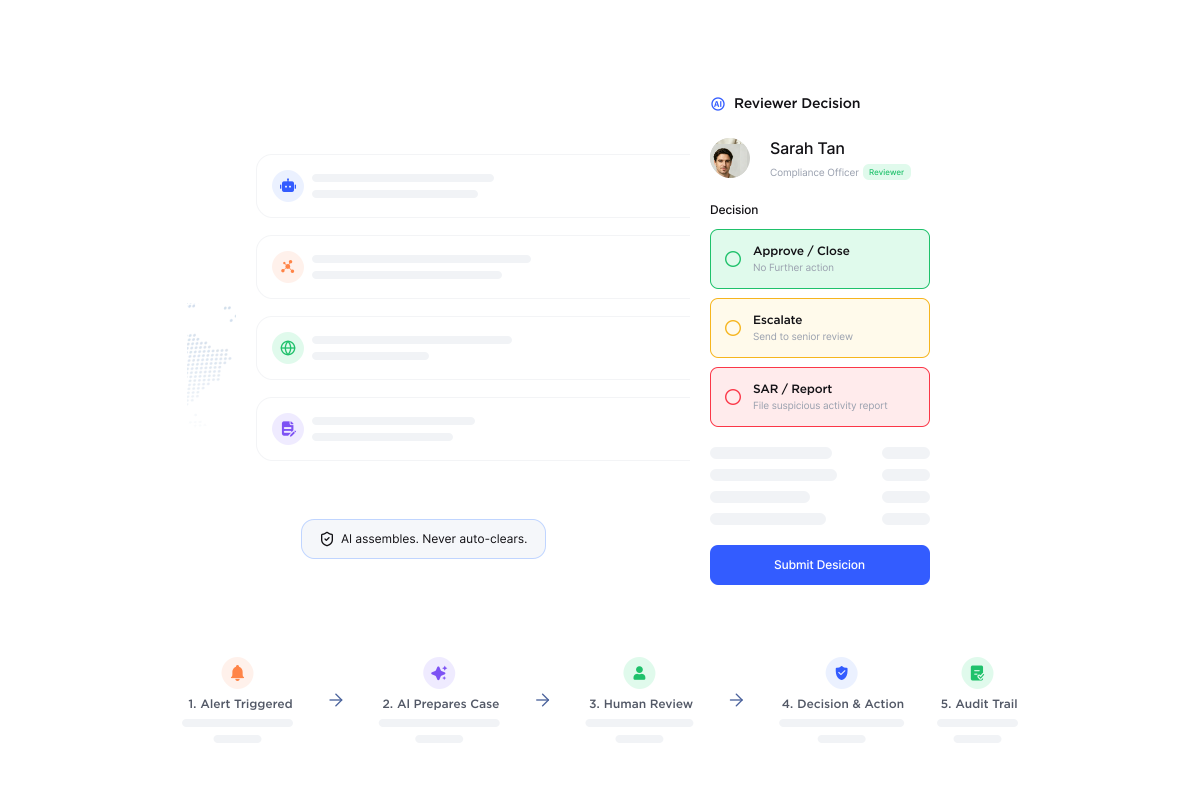
Decisions Stay with Your Team

AI Reviewer recommends the disposition. Your reviewer decides. You set the rules for when an alert may be recommended for closure and when it must escalate, and a reviewer approves every disposition before it takes effect. MLROs and senior officers can override any recommendation, and the override is recorded with its reason.

Built to Stand Up to Your Examiner

Every step of every review is written to the audit log, so any decision can be traced back through its reasoning chain to the evidence it used.

Captured

  • Source alert and extracted evidence
  • Rules and policy version applied
  • Each agent's output and the critic's challenge
  • Confidence score and flagged uncertainty
  • Recommended disposition
  • Reviewer, decision, edits and timestamp
Aligned with
MAS FEAT principles and HKMA expectations on generative AI governance and auditability.
AI assistance
Reports and rationales are drafted in 16+ languages, including non-Latin scripts and transliterated names. Your reviewer can edit any draft before approving it.
Sources
MAS FEAT Principles (Monetary Authority of Singapore) · HKMA guidance on generative AI (exact HKMA document title to confirm in the HTML pass)

Trusted by Regulated Institutions Since 2014

500+regulated institutions*
180+jurisdictions*
ISO/IEC 27001certified
ISO/IEC 27701certified

*Cumulative since 2014.

Before You Get Started

What is Level-1 alert review?

Level-1 alert review is the first look at a compliance alert, such as a sanctions screening hit or a transaction monitoring alert, to decide whether it is a false positive that can be closed or needs escalation to a more senior Level-2 analyst. It is usually the largest and most repetitive part of the queue. WIDTH AI Reviewer prepares each Level-1 alert in under 2 minutes, and a reviewer approves the outcome.

How does AI alert review reduce false positives?

AI alert review reduces the work false positives create by preparing each alert, not by ignoring alerts. It gathers the customer, transaction and screening evidence, compares the hit with what is known, such as a different date of birth or nationality on a name match, and recommends closure where the evidence supports it. WIDTH AI Reviewer auto-triages around 75% of false positives for closure, and a reviewer approves each one.

What types of alerts can AI Reviewer prepare?

WIDTH AI Reviewer prepares Level-1 alerts from onboarding, name screening, Transaction Monitoring and KYT inside Case Management. It can also take alerts from your own systems in three input formats over a REST API. Each alert is reviewed as a full case file, with the customer's history and earlier alerts.

How do we know why AI Reviewer recommended something?

Every AI Reviewer recommendation includes a human-readable rationale that cites its sources, flags uncertainty and surfaces gaps or contradictions in the evidence. The full reasoning chain, including the critic agent's challenge, is kept in the audit log. Your reviewer can edit any draft before approving it.

Is AI Reviewer just one large language model?

No. AI Reviewer is a deterministic and AI hybrid. Rule-based stages handle intake, policy selection and the final tiering. AI stages handle reasoning, and a separate critic agent cross-checks them, so decisions stay controllable and repeatable. Every step is written to the audit log.

How fast is AI alert review with AI Reviewer?

A prepared decision typically takes under 2 minutes per alert with WIDTH AI Reviewer, compared with hours for a manual Level-1 case. Your reviewer's approval time comes on top, and times depend on alert type, data quality and the rules you configure.

Can AI Reviewer review alerts from our existing systems?

Yes. AI Reviewer accepts alerts in three input formats over a REST API, with synchronous or streaming responses. It also works natively on alerts raised in WIDTH, so you can start with your current alert sources. A reviewer still approves every disposition.

Who is AI Reviewer built for?

WIDTH AI Reviewer is built for compliance teams with a high volume of Level-1 alerts: banks and digital banks, payment firms (EMIs and PSPs), exchanges and VASPs, asset and wealth managers, and DNFBPs. It also helps teams that review names in non-Latin scripts, with reports in 16+ languages.

Can AI Reviewer close alerts automatically?

No. AI Reviewer recommends a disposition, and your auto-close and escalation rules decide which tier that recommendation sits in. A reviewer approves before any disposition takes effect, MLROs can override any recommendation with a recorded reason, and nothing closes silently.

See How It Fits Your Alert Queue

Bring a recent alert. We'll run it through AI Reviewer and walk you through the evidence, the rationale and the audit record.

AI on the work. People on the decision. Evidence on the record.