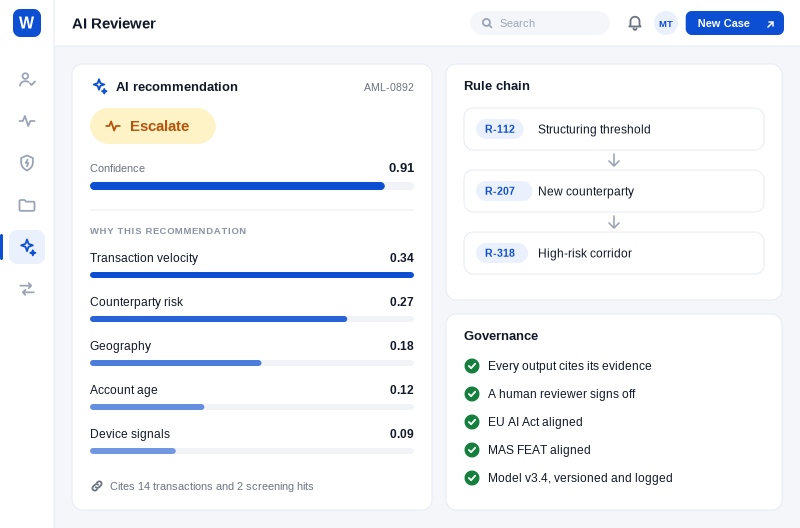
AI That Prepares the Work, So Your Team Can Make the Call
Compliance teams don't need AI to replace the analyst. They need fewer hours spent gathering evidence before the analyst can decide. WIDTH AI assembles the context, triages alerts and drafts the narrative, and a person approves every outcome.
Built for compliance leaders, MLROs and analyst teams who need AI they can explain to an examiner
<2minper Level-1 alert decision, down from hours
~75%of false positives auto-triaged for closure, each approved by a reviewer
100%of AI Reviewer decisions explainable and audit-ready
16+report languages, including non-Latin scripts and transliterated names
AI Reviewer figures. The false-positive rate depends on your alert sources and rules. A reviewer approves every disposition; nothing closes silently.
What is AI for AML Compliance?
AI for AML compliance uses machine learning and language models to gather evidence, triage alerts and draft case narratives, while people keep the decision. WIDTH AI runs inside the WIDTH platform: AI Reviewer prepares each Level-1 alert in under 2 minutes, and a reviewer approves every disposition. 100% of AI Reviewer decisions are explainable and audit-ready.
Level-1 alerts
under 2 minutes per alert decision with AI Reviewer, down from hours
False positives
around 75% auto-triaged for closure; a reviewer approves each one
Explainability
100% of AI Reviewer decisions explainable and audit-ready
Pipeline
5 specialist agents and 7 stages (3 deterministic, 4 AI)
Report languages
16+, including non-Latin scripts and transliterated names
Governance
designed in line with MAS FEAT principles and HKMA expectations on generative AI
The Judgement Takes Minutes. Preparing It Takes Hours.
An analyst opens an AML alert. Before deciding anything, they check the customer profile, expected activity, earlier transactions, counterparties, screening results, previous cases and relationships. Multiply that by a full Level-1 queue and the backlog never clears.
Generic AI makes it faster but harder to defend. A single model call can't show what evidence it used, which rule applied or who signed off. WIDTH AI is built the other way round: rules and guardrails around every AI step, and a named reviewer on every decision.
Alert Backlogs
Hours per Level-1 case, most of which turn out to be false positives.
Black-Box Outputs
A score or summary without sources can't be explained to an examiner.
Blurred Accountability
When AI acts alone, nobody can say who decided and on what evidence.
Who It's For
Compliance leaders, MLROs and Level-1 and Level-2 analysts at banks and digital banks, EMIs and PSPs, exchanges and VASPs, asset and wealth managers and DNFBPs
Problems It Solves
Level-1 backlogs
Hours spent assembling evidence
Inconsistent dispositions
AI outputs that can't be explained
Unclear ownership of AI-assisted decisions
Where It Fits
Every stage, especially Investigate and Decide and record. AI works inside onboarding, monitoring, fraud and case workflows.
How It Fits Your Stack
Runs inside the WIDTH platform on the same customer record
AI Reviewer also accepts alerts from your existing systems through REST (sync or streamed)
What You Get
Every Alert Gets a Full Case-File Review
Problem
Analysts gather the same information for every alert.
What WIDTH does
AI Reviewer's five specialist agents extract the evidence, apply your jurisdiction's rulebook, reason through the case, score their confidence and recommend a disposition.
Result
Under 2 minutes per Level-1 alert decision.
Less Noise, No Silent Closures
Problem
Most alerts are false positives, but closing them still takes analyst time.
What WIDTH does
Auto-triages around 75% of false positives for closure and escalates only what needs a person.
Result
A reviewer approves every disposition, and your team's time goes to the cases that matter.
A Controllable Pipeline, Not a Black Box
Problem
A single model call can't be reproduced or explained.
What WIDTH does
Deterministic stages bookend the AI stages, so intake, policy matching and the final decision tier follow fixed rules.
Result
Decisions stay controllable and repeatable, and every step is written to the audit log.
Governance for AI Agents Outside Your Walls
Problem
AI agents are starting to act for customers and businesses, often with no verified identity or limits.
What WIDTH does
Know Your Agent (early access) links each agent to a verified principal, records what it may do, and logs what it did.
Result
The same accountability you expect from your own AI applies to agents you deal with.
See How AI Reviewer Reaches a Recommendation
Five specialist agents work through every alert. Each one cites its sources, and the result waits for a reviewer.
AI Reviewer pipelineAwaiting reviewer
01 Extract
Turns every upstream signal into structured evidence
02 Policy rules
Applies the rulebook for the jurisdiction and industry
03 Reason
Chains the case end to end and surfaces gaps and contradictions
04 Evaluate
Scores confidence, flags uncertainty and cites every source
05 Refine
Recommends a disposition with a justification that can be replayed for audit
Recommended: Close as false positive · Confidence: High · 6 sources citedApproveEscalateAwaiting reviewer
Illustrative product view · Demo data
Evidence-LinkedEvery point in the rationale links to its source.
Gaps SurfacedContradictions and missing information are flagged, not smoothed over.
Reviewer ApprovesNothing is closed until a person signs off.
Match Automation to the Task
Some work is repetitive and well defined. Some benefits from assistance. Some involves ambiguity, material risk or professional judgement. Treating all three the same creates unnecessary risk.
Automate the repeatable: use deterministic rules where the process is clearly defined and your policies permit it.
Assist the reviewer: use AI to organise information, surface relevant evidence and recommend an outcome.
Escalate the ambiguous: send higher-risk, unusual or uncertain cases to the people responsible for the judgement.
Not "how much compliance work can we automate?" but "which parts of the work can AI reduce without weakening the control around the decision?"
Guardrails at Every Stage
The AI Reviewer pipeline, seven stages:
Stage
Type
What It Does
01 Ingest and normalise
Deterministic
Takes alerts in three input formats, via REST sync or streaming
02 Policy match
Deterministic
Matches the alert to the right jurisdiction and industry rulebook
03 SOP runner
AI
Works through the strategic compliance questions in your procedure
04 Check runner
AI
Runs the batched tactical checks
05 Critic cross-review
AI
A second agent challenges the first agent's reasoning
06 Decision and tier
Deterministic
Applies your closure and escalation rules
07 Summary and report
AI
Writes the headline, verdict and actions for the reviewer
AI Across the Lifecycle
Onboard
In KYC and KYB reviews, AI organises the applicant's information and flags what needs a closer look. Your rules still decide what evidence is required.
Monitor
AI prioritises monitoring alerts and prepares each one with customer and transaction context.
Detect
Identity, device, behaviour, transaction and relationship signals are assessed together, not one event at a time.
Investigate
AI summarises the evidence, drafts the case narrative and prepares SAR or STR text for your team to review.
Decide and record
The AI recommendation, the reviewer's decision and the evidence are stored together.
AI Should Not Blur Responsibility
WIDTH AI recommends. Your team decides. You set where AI assists, where escalation applies and which outcomes need approval. Every disposition is approved by a reviewer, and filing and reporting decisions remain with your compliance officers.
Controls
Review points
Role-based access
Evidence-linked review
Decision history
Human accountability
Policy alignment (you define where AI may assist, where escalation applies and which outcomes need approval)
Built to Stand Up to Your Examiner
Explainable by design
Every disposition carries a human-readable rationale linked to its evidence.
Deterministic and AI hybrid
Rules and guardrails, not a single opaque model call.
Human in the loop
A reviewer approves before disposition. Nothing closes silently.
Aligned with regulator expectations
Designed in line with MAS FEAT principles and HKMA expectations on generative AI governance and auditability.
Captured for Every Decision
The inputs
The rulebook applied
Each agent's reasoning and sources
The confidence score
The recommendation
The reviewer, their decision and any edits
Timestamps
The human-readable rationale, linked to its evidence
Languages
Reports in 16+ languages, including non-Latin scripts and transliterated names.
Sources
MAS FEAT Principles (Monetary Authority of Singapore) · HKMA guidance on generative AI (exact HKMA document title to confirm in the HTML pass)
Trusted by Regulated Institutions Since 2014
Advised by former regulators and financial-intelligence leaders, including a former Deputy Head of Hong Kong's Joint Financial Intelligence Unit and a former Chief Executive of the Dubai Financial Services Authority.
AI is used in AML compliance to do the preparation around a decision: gathering customer and transaction evidence, triaging alerts, flagging gaps and drafting case narratives and report text. The decision itself stays with a person. In WIDTH, AI Reviewer prepares each Level-1 alert in under 2 minutes and recommends a disposition, and a reviewer approves it before anything closes.
What is Know Your Agent?
Know Your Agent is an early-access WIDTH product that verifies AI agents acting for customers or businesses: who is behind the agent, what it may do and what it did. Each agent is linked to a person or business verified through KYC or KYB, and every action is recorded against the human who authorised it.
How does WIDTH stop AI from making things up?
WIDTH limits the risk of invented content by tying every AI recommendation to the case evidence and keeping a person on the decision. Each point in the rationale links to its source, a separate critic agent challenges the first agent's reasoning, and deterministic stages handle intake, policy matching and the final tier. Gaps and contradictions are flagged, not smoothed over, and a reviewer approves every disposition.
Can AI for AML compliance be explained to a regulator?
Yes, when the AI shows its working. Every WIDTH AI Reviewer disposition comes with a human-readable rationale that cites its evidence, the rulebook applied and the confidence score, and every step is written to the audit log. 100% of AI Reviewer decisions are explainable and audit-ready.
Do regulators accept AI for AML compliance reviews?
Regulators generally expect firms that use AI in AML work to explain its outputs, keep human oversight and stay accountable for the decision. Expectations differ by regulator, and acceptance depends on how the AI is governed, not on the tool alone. WIDTH supports this by recording the AI rationale, its sources, the reviewer and their decision for every alert, so you can show how each outcome was reached.
Which AI governance expectations does WIDTH AI follow?
WIDTH AI is designed in line with MAS FEAT principles and HKMA expectations on generative AI governance and auditability. Your organisation remains responsible for its own model governance and regulatory obligations; WIDTH keeps the records that help you evidence them.
Who is WIDTH AI built for?
WIDTH AI is built for compliance leaders, MLROs and analyst teams at regulated institutions, including banks, payment firms, digital asset businesses, wealth managers and DNFBPs. It suits teams with large Level-1 alert queues who need AI they can explain to an examiner.
Does WIDTH AI replace compliance analysts?
No, WIDTH AI does not replace analysts. AI prepares the evidence and recommends an outcome. Analysts and approvers make the decision, especially on higher-risk, ambiguous or material cases, and their time moves from gathering evidence to judging it. WIDTH records who approved each outcome.
Does WIDTH AI close alerts on its own?
No. AI Reviewer auto-triages likely false positives and recommends closure, but a reviewer approves every disposition before it takes effect. Around 75% of false positives are routed to a closure recommendation, and nothing closes silently. Your rules decide which recommendations may close and which must escalate.
See How It Fits Your Review Process
Bring a recent alert. We'll run it through AI Reviewer and walk you through the evidence, the recommendation and the audit record.
AI on the work. People on the decision. Evidence on the record.