Onboard People and Businesses on One Record

Identity checks, business verification, screening and manual review usually sit in separate tools, so every approval is pieced together by hand. WIDTH runs KYC, KYB, screening and the risk decision as one workflow, from intake to decision.

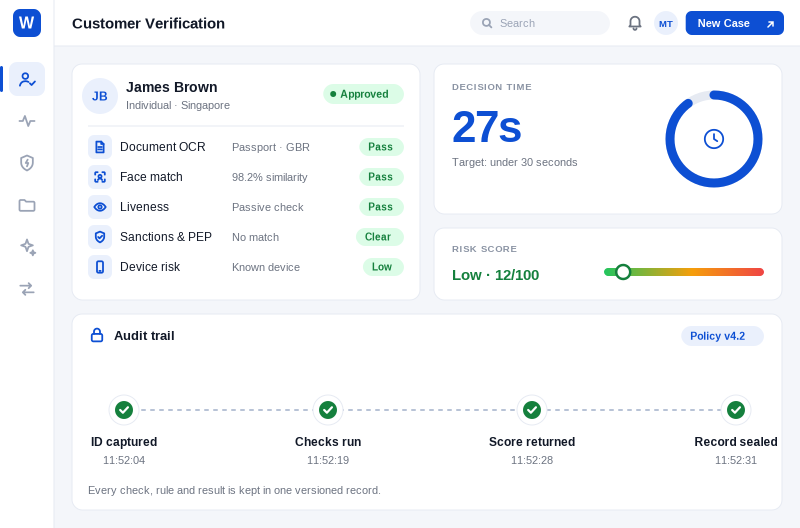
Illustrative WIDTH KYC review showing verification and screening results, a risk score and the audit trail.

Built for onboarding and compliance teams at banks, payment firms, fintechs, digital asset businesses, insurers and professional services firms

KYC time measured from document and selfie upload to decision. Coverage depends on document type, jurisdiction, device and configuration.

Full KYC at US$0.50 per checkFor digital asset businesses, with wallet address screening included. Offer ends 31 Dec 2026. T&Cs apply.
See Pricing →

What is Digital Customer Onboarding?

Digital customer onboarding is the process of verifying, screening and approving a new customer remotely, through an app or website, before their account is opened. WIDTH Onboarding runs KYC for individuals, KYB for businesses, screening and the risk decision as one workflow on one record. A full KYC check returns a decision in under 30 seconds.

Full KYC
under 30 seconds, from document and selfie upload to decision
Core KYC checks
4 (ID verification, 1:1 face match, passive liveness, device and IP analysis)
ID document types
16,000+, for individual customers, directors and UBOs
UBO threshold
25% by default, configurable
KYB reviews
next review at 12 months, or sooner when something changes
Wallet screening
up to 5 hops across 8 chains, with a 0–100 risk score

Every Approval is Pieced Together from Separate Tools

The ID check lives in one system, screening in another, ownership research in a spreadsheet and the approval in an email. Genuine customers wait while analysts reconcile results, and the file an auditor asks for has to be rebuilt.

WIDTH keeps every step on one onboarding record. The identity evidence, the ownership structure, the screening outcome and the reviewer's decision stay together and carry into monitoring once the customer is live.

Verification Sits Apart from Screening

The document result and the sanctions hit are reviewed in different places.

Ownership Review Restarts Outside the Record

UBO research happens in spreadsheets and is lost by the next review.

Every Decision is Reassembled

Proving what was checked, and why the customer was approved, means collecting evidence from several tools.

Who It's For

Onboarding and compliance teams at banks and digital banks, payment firms, fintechs and neobanks, exchanges and VASPs, insurers, wealth managers and professional services firms

Problems It Solves

  • Separate KYC, KYB and screening tools
  • Fake and duplicate sign-ups
  • UBO research done by hand
  • Slow manual review
  • Audit files rebuilt for every customer

Where It Fits

Onboard and Screen. The onboarding record carries into AML Monitoring, Fraud Detection and Case Management.

How It Fits Your Stack

  • Web, iOS, Android and Flutter SDKs
  • REST API and webhooks
  • The WIDTH dashboard for reviewers
  • Your existing data and screening providers where supported

What You Get

Verify the Person in Under 30 Seconds

Problem
Document-only checks miss impersonation and repeat applicants.
What WIDTH does
ID verification, 1:1 face match, passive liveness, and device and IP analysis run in one capture.
Result
A full KYC decision in under 30 seconds. → KYC Onboarding

Verify the Business and Who Owns It

Problem
Ownership hides behind layers of companies.
What WIDTH does
Pulls the company record where a registry source is available, expands corporate shareholders until natural persons are reached at your configured threshold (25% by default), and runs each director and owner through KYC.
Result
The ownership structure and every check stay on one record. → KYB Onboarding

Screen Before You Decide

Problem
Screening runs elsewhere and arrives as unexplained hits.
What WIDTH does
Screens individuals, companies, directors and owners against sanctions, PEP and adverse media, and digital asset businesses can add wallet address screening.
Result
Analysts see why a match fired, next to everything else they know.

Decide on Your Rules, Review Only the Exceptions

Problem
Every applicant ends up in the same manual queue.
What WIDTH does
Applies your onboarding rules and thresholds, approves clear cases and routes exceptions to a reviewer with the evidence attached.
Result
Your team reviews the applicants that need a person, not the whole queue.

See One Onboarding Record, from Intake to Approval

The company, its owners, the screening outcome and the review history stay attached for the next review.

  • Ownership ExpandedSee the companies between the applicant and the people who own it.
  • Every Party CheckedDirectors and owners are verified and screened on the same record.
  • Review on Your RulesComplex ownership goes to the reviewer your policy names.

How It Works

StepWhat HappensProduct
01 CollectCapture individual or business details in the journey your customers already use. KYB can start with the minimum company data and collect directors, shareholders and documents step by step.KYC · KYB
02 VerifyCheck the document, read its data (visual zone, MRZ, barcode, and the chip where supported), match the face, confirm liveness and check the device. For businesses, match the registry record and expand ownership.KYC · KYB
03 ScreenScreen the applicant, the company and every director and owner against sanctions, PEP and adverse media. Add wallet address screening for digital asset customers.Onboarding · KYT
04 AssessApply your onboarding rules and risk thresholds, and set the first risk rating.Onboarding
05 ReviewRoute exceptions to a reviewer with the evidence attached. AI Reviewer can prepare each one.Case Management · AI Reviewer
06 Decide and recordRecord the outcome, the reviewer and the evidence, ready for the next review and for monitoring.Onboarding

For Digital Asset Businesses: Wallet Address Screening

Screen wallet addresses alongside every KYC check. WIDTH checks a wallet's own risk, its direct links to high-risk entities and its indirect exposure through intermediaries, up to 5 hops, across 8 chains. Each wallet gets a 0–100 risk score with the triggered rules and the full fund path. → KYT

Beyond the First Check: re-KYC and re-KYB

Due diligence doesn't end at approval. WIDTH triggers another review when the risk changes: a sanctions list update, a change of address, a new director or shareholder, an adverse media hit, or unusual activity flagged by monitoring. It re-collects only what changed. Calendar-based reviews stay available for segments that need them.

Decisions Stay with Your Team

You set the onboarding rules, the risk thresholds, the UBO threshold and which cases need a person. WIDTH runs the checks and recommends an outcome. Your reviewers approve the exceptions, and each decision is recorded against the person who made it.

One Onboarding Record Answers Every Question

What was collected
The customer or business information gathered during onboarding
What was checked
Verification results, ownership structure, screening outcomes and risk signals
Who reviewed it
The reviewer, their notes, any escalation and the questions they raised
What was decided
The outcome, the rule and policy version in force, and the timestamp
Supports your obligations under
FATF Recommendations 10 and 24 and local customer due diligence and beneficial ownership rules, configurable for MAS Notice 626, the HKMA AML/CFT Guideline and similar regimes.
Sources
FATF Recommendations (fatf-gafi.org) · MAS Notice 626 on Prevention of Money Laundering and Countering the Financing of Terrorism (Banks) · HKMA Guideline on Anti-Money Laundering and Counter-Financing of Terrorism

Trusted by Regulated Institutions Since 2014

500+regulated institutions*
180+jurisdictions*
ISO/IEC 27001certified
ISO/IEC 27701certified

*Cumulative since 2014.

Before You Get Started

What is digital customer onboarding?

Digital customer onboarding is the remote process of verifying, screening and approving a new customer through an app or website, instead of in a branch. For individuals it means an ID document, a selfie and screening; for businesses it adds the company record and its owners. WIDTH Onboarding runs both as one workflow, and a full KYC check returns a decision in under 30 seconds.

What is the difference between KYC and KYB?

KYC (know your customer) verifies an individual: their identity document, face, liveness and screening results. KYB (know your business) verifies a company: its registry record, directors, shareholders and ultimate beneficial owners. In WIDTH Onboarding the two connect, because each director and UBO found during KYB goes through the same KYC check on the same record.

Does WIDTH support both KYC and KYB?

Yes. WIDTH KYC verifies individuals with ID verification, 1:1 face match, passive liveness, and device and IP analysis. WIDTH KYB verifies the company, its directors and shareholders, and its beneficial owners at your threshold (25% by default), then runs the relevant people through KYC.

Who is WIDTH Onboarding built for?

WIDTH Onboarding is built for regulated and risk-sensitive organisations that onboard individuals, businesses or both, including banks, payment firms, fintechs, digital asset businesses, insurers, wealth managers and professional services firms. Teams can onboard individuals through KYC, businesses through KYB, or both on one record.

Can we keep our existing onboarding journey?

Yes. Embed the WIDTH Web, iOS, Android or Flutter SDK, or call the REST API, in the journey your customers already use. Results return to your backend, and reviewers work in the WIDTH dashboard. Teams that prefer no build can start in the WIDTH dashboard.

Can we change our digital customer onboarding flow without engineering?

Yes, for the workflow itself. Onboarding rules, thresholds and review steps are set in WIDTH, and KYB starts from a ready-made template in a visual builder where you add events, actions, rules and decisions, then validate, test and publish your own version. Changes to the screens inside your own app still follow your release process.

What happens after a customer is onboarded?

The WIDTH onboarding record carries into ongoing screening, AML monitoring, fraud detection and case management, so later alerts arrive with the customer's history. Re-KYC and re-KYB are triggered when risk changes, and WIDTH re-collects only what changed. Nothing is rebuilt between stages.

Can digital asset businesses screen wallets at onboarding?

Yes. WIDTH wallet address screening traces a wallet's direct and indirect exposure up to 5 hops across 8 chains and returns a 0–100 risk score with the rules that triggered it and the full fund path. It is included in the US$0.50 KYC offer for digital asset businesses until 31 Dec 2026 (T&Cs apply).

Does WIDTH decide who we onboard?

No, WIDTH does not decide who you onboard. WIDTH applies the rules you configure and recommends an outcome. Your team reviews exceptions and owns every decision, and each decision is recorded against the reviewer who made it. Filing reports and exiting customers remain your organisation's decisions.

See How It Fits Your Onboarding Journey

Onboard a live individual and a live company with the WIDTH team, then export the full record.

AI on the work. People on the decision. Evidence on the record.