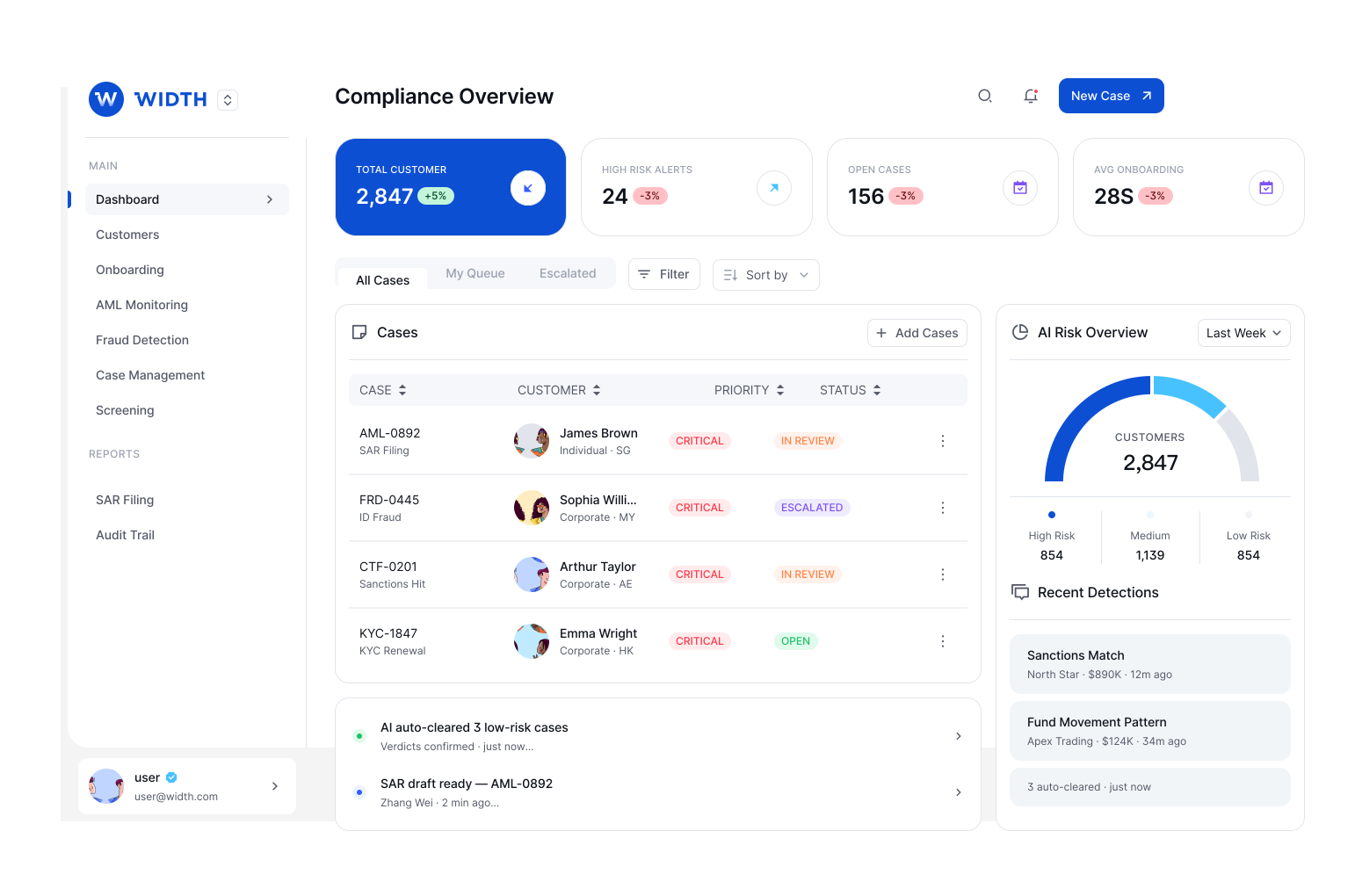
What Does AML Compliance for Banks Involve?
AML compliance for banks covers verifying customers and corporate owners, screening them against sanctions and PEP lists, monitoring accounts, investigating alerts and recording every decision. WIDTH connects those stages on one customer record for retail, corporate and correspondent relationships. A full KYC check takes under 30 seconds, and every AI Reviewer decision is explainable and reviewer-approved.
- KYC
- full check in under 30 seconds (ID, 1:1 face match, passive liveness, device and IP)
- UBO threshold
- 25% by default, configurable
- KYB reviews
- next review in 12 months, or sooner on a change
- Screening
- 8 scripts matched natively, Chinese names included
- AI Reviewer
- under 2 minutes per Level-1 alert decision · 100% of decisions explainable and audit-ready
- Company
- 500+ regulated institutions* · 180+ jurisdictions* · ISO/IEC 27001 and 27701 certified
The Risk You Assessed at Onboarding Doesn't Stay Put
A customer passes onboarding today and presents a different risk six months later. A director changes, a counterparty appears on a sanctions list, or a dormant account starts moving funds in round amounts. When onboarding, screening, monitoring and investigations each keep their own records, nobody sees the change until an alert forces the question.
WIDTH connects those stages on one customer record, so the next review starts with what the bank already knows.
Corporate Files That Go Stale
Ownership traced by hand at onboarding is out of date by the periodic review, and changes in between go unseen.
Alerts Without the Customer
Analysts open a monitoring alert and spend hours finding the profile, the earlier reviews and the connected accounts.
Evidence Spread Across Systems
When an examiner asks how a decision was made, the answer sits in emails, spreadsheets and three different tools.
Who It's For
- Retail and digital banks
- Corporate and transaction banks
- Private banks
- Correspondent banking teams
- KYC operations, financial crime and MLRO functions
What You're Up Against
- Obligations such as FATF Recommendations 10, 13, 20 and 24, MAS Notice 626 and the HKMA AML/CFT Guideline
- Layered corporate ownership
- Mule accounts
- Nested correspondent exposure
- Model and AI governance expectations
Problems It Solves
- Fragmented customer records
- Stale corporate files
- Level-1 alert backlogs
- Investigations that start from an empty file
- Evidence rebuilt for every examination
How WIDTH Fits
- Start with one module or the full lifecycle
- REST API, webhooks and SDKs alongside your core banking and existing monitoring
- WIDTH dashboard for analysts and approvers
Across Your Customer Lifecycle
| Stage | WIDTH Product | What It Does for a Bank | Proof |
|---|---|---|---|
| Onboard | KYC Onboarding · KYB Onboarding | Verify individuals and businesses, trace corporate ownership to every UBO, and verify each director and UBO in the same case | KYC in under 30 seconds · 25% UBO threshold, configurable |
| Screen | Screening (in Onboarding) | Screen customers, directors, owners and counterparties against sanctions, PEP and adverse media, with names matched natively across scripts | 8 scripts matched natively, Chinese names included |
| Monitor | AML Monitoring · Transaction Monitoring | Monitor accounts against scenarios tuned to your products and segments, and re-review corporate clients when a director, owner or risk changes | 12-month review, or sooner on a change |
| Detect | Fraud Detection | Read identity, device, behaviour, transaction and relationship signals together to catch account takeover, scams and mule accounts | 4 core checks at sign-up, including device and IP |
| Investigate | AI Reviewer · Graph Intelligence · Case Management | AI prepares Level-1 reviews; Graph shows the owners, accounts and counterparties around a case | Under 2 minutes per alert; ~75% of false positives auto-triaged, reviewer approves |
| Decide and record | Case Management | Escalate to senior review and the MLRO, record sign-off and keep the evidence with the decision | 100% of AI Reviewer decisions explainable |
Correspondent and corporate banking: for respondent banks and corporate clients, KYB traces ownership through every layer, Graph Intelligence surfaces shared directors and UBOs across your book, and the relationship is reviewed again when something changes, not only at the annual review.
One Corporate Client, One Record
- TriggerTransaction monitoring alert, corridor risk, raised 14 days after the last periodic review.
- ContextCustomer profile, ownership structure and two earlier screening matches attached at triage.
- AI reviewAI Reviewer assembled the case in under 2 minutes and recommended escalation; the Tier 1 reviewer approved.
- RelationshipsGraph Intelligence linked a director to two other customers with shared ownership.
- ReviewSecond reviewer required by internal policy; completed.
- OutcomeReported, customer risk rating raised, review interval shortened.
Illustrative record · Demo data
Recommended Stack
Decisions Stay with Your Team
WIDTH applies your risk methodology, prepares the evidence and recommends. Your analysts, approvers and MLRO decide, and every decision is recorded against the person who made it. Filing reports with your financial intelligence unit remains the bank's decision.
Ready When the Examiner Asks
What Examiners Ask
- How the customer was verified and risk-rated
- Who owns the corporate client and how you know
- Why an alert was closed or escalated
- Who approved the decision and when
- What changed since the last review
- Which policy version applied at the time
- Where it is in WIDTH
- One customer record holding KYC and KYB evidence, the ownership structure, screening hits and how they were resolved, alert history, AI Reviewer rationale, reviewer and approver actions, policy versions and timestamps, exportable for review
- Sources
- FATF Recommendations (fatf-gafi.org) · MAS Notice 626 · HKMA AML/CFT Guideline · MAS FEAT principles
Trusted by Regulated Institutions Since 2014
*Cumulative since 2014.
FAQ
What AML compliance obligations do banks have?
Banks must verify customers and their beneficial owners, apply extra checks to correspondent relationships, screen against sanctions, monitor accounts and report suspicious activity. These duties come from the FATF Recommendations, including Recommendations 10, 13, 20 and 24, as applied by local rules such as MAS Notice 626 and the HKMA AML/CFT Guideline. WIDTH supports those obligations; meeting them remains the bank's responsibility.
How do banks reduce AML false positives?
Banks reduce AML false positives by tuning scenarios to their products and segments, matching names natively rather than through transliteration, and giving analysts the customer context with each alert. WIDTH AI Reviewer prepares each Level-1 alert in under 2 minutes and auto-triages around 75% of false positives for closure. A reviewer approves every disposition before it takes effect.
What evidence do examiners expect from a bank's AML programme?
Examiners usually ask how a customer was verified and risk-rated, who owns a corporate client and how the bank knows, why an alert was closed or escalated, who approved the decision and when, and what changed since the last review. WIDTH keeps that on one customer record, with KYC and KYB evidence, screening resolutions, alert history, AI Reviewer rationale, approver actions, policy versions and timestamps, exportable for review.
How does WIDTH support correspondent banking due diligence?
WIDTH KYB traces the ownership of a respondent bank or corporate client through every layer to each UBO at your threshold, 25% by default, and verifies each director and UBO in the same case. Graph Intelligence surfaces shared directors and UBOs across your book. The case reopens when a director, owner or risk changes, not only at the annual review.
How is AI governed when banks use WIDTH?
AI Reviewer runs deterministic guardrails around its AI stages, gives every disposition an evidence-linked rationale, and needs reviewer approval before any alert closes. Every AI Reviewer decision is explainable and audit-ready, and the rationale and approver stay on the case. AI Reviewer is designed in line with MAS FEAT and HKMA GenAI expectations.
Can WIDTH work alongside our existing core banking and monitoring systems?
Yes. WIDTH connects to core banking and existing monitoring through REST APIs, webhooks and SDKs, so a bank can start with one module or the full lifecycle. AI Reviewer can also review alerts raised by your own monitoring systems, and analysts and approvers work in the WIDTH dashboard.
Is WIDTH certified?
Yes. WIDTH is ISO/IEC 27001 and ISO/IEC 27701 certified and supports GDPR requirements. WIDTH has worked with regulated institutions since 2014, from offices in Singapore, Hong Kong and Beijing, and has served 500+ regulated institutions across 180+ jurisdictions, counted cumulatively since 2014.
Which WIDTH products do banks start with for AML compliance?
Most banks start with Onboarding (KYC and KYB), AML Monitoring and Case Management, so verification, monitoring and decisions sit on one customer record. They then add AI Reviewer for Level-1 alert backlogs, Graph Intelligence for corporate and correspondent networks, and Fraud Detection for retail and digital channels.
Does WIDTH decide for us?
No. WIDTH applies your risk methodology, prepares the evidence and recommends. Your analysts, approvers and MLRO make and sign off every decision, and each decision is recorded against the person who made it. Filing reports with your financial intelligence unit remains the bank's decision.
See How WIDTH Fits Your Bank
Walk through one corporate client, from onboarding to a signed-off case, with the WIDTH team.
AI on the work. People on the decision. Evidence on the record.