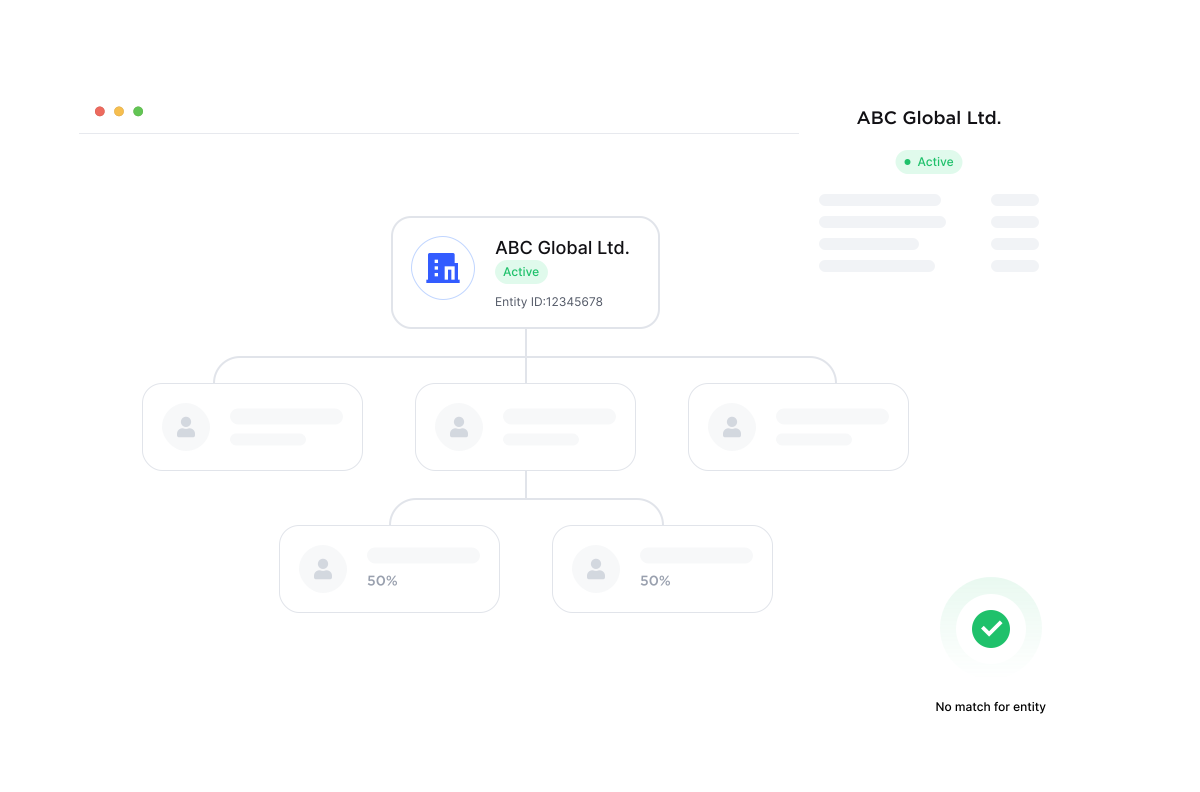
Verify the Business and Who Owns It

Ownership traced by hand goes stale, and the evidence ends up in an inbox. WIDTH brings the company record, directors, shareholders and beneficial owners into one KYB case, screens every party, and reviews the case again when something changes.

KYB verification: the business and who owns it

Built for banks, payment firms, fintechs, digital asset businesses and corporate service providers that onboard businesses

Review interval and threshold are set by your policy. KYC time is measured from document and selfie upload to decision.

What is KYB Verification?

KYB (know your business) verification confirms that a company is real, identifies who owns and controls it, and checks the people behind it. WIDTH KYB Onboarding puts the company record, directors, shareholders and UBOs on one case and screens every party. Ownership is traced to natural persons at a 25% threshold by default, which you can change.

UBO threshold
25% by default, configurable
Director and UBO KYC
a decision in under 30 seconds per person, against 16,000+ ID document types
Name matching
8 scripts matched natively, Chinese names included
Review triggers
4 you can switch on (director or shareholder change, new sanctions or adverse media hit, transaction anomaly, periodic review)
Next review
12 months by default, or sooner when something changes
Registry coverage
200+ corporate registry sources

The Company is Rarely the Whole Story

A business application gives you a name and a registration number. The risk sits in who owns it, who controls it and who signs for it. That information is spread across registries, shareholder filings and documents the applicant sends late, and it keeps changing after you approve.

WIDTH keeps the company and every related party on one case, from the first registry check to the next review.

Owners Hidden in Layers

Holding companies and nominee structures hide the people who really own the business.

Owners Checked Somewhere Else

The company is screened in one tool and its directors are verified in another, so the evidence never joins up.

Records That Go Stale

A director changes or an owner is sanctioned, and nobody looks at the file until the annual review.

Who It's For

  • Banks onboarding corporate clients
  • Payment firms and acquirers onboarding merchants
  • Fintechs and neobanks with business accounts
  • Exchanges and custodians onboarding institutions
  • Corporate service providers

Problems It Solves

  • Hidden beneficial owners
  • Directors and owners verified outside the case
  • Chasing documents by email
  • Chinese and other non-Latin names mismatched
  • Files that go stale between annual reviews

Where It Fits

Onboard, Screen and Monitor. Ownership feeds Graph Intelligence; the business carries into AML Monitoring and Case Management on the same record.

How It Fits Your Stack

  • Start from a ready-made KYB template
  • One customer link collects every party, document and form
  • REST API and webhooks
  • Or the WIDTH dashboard with no build

What You Get

One Record, from Company to UBO

Problem
The company file, the ownership chart and the owners' ID checks live in different places.
What WIDTH does
Puts the registry record, incorporation documents, directors, shareholders, ownership structure, UBOs and their screening on one case. Ownership is traced through every layer to the people above your threshold (25% by default).
Result
KYB approved with ownership traced to every UBO, and every party, document, check and decision on one case.

Owners Verified in the Same Case

Problem
The business passes, but nobody verified the person who signs.
What WIDTH does
Each director and UBO goes through the same KYC as your individual customers. That means ID verification against 16,000+ document types and a decision in under 30 seconds. Every party is screened against sanctions, PEP and adverse media.
Result
One audit trail for the business and everyone behind it.

Kept Current, Not Reviewed Once a Year

Problem
Fixed review cycles miss the change that matters.
What WIDTH does
You switch on the triggers you need: a director or shareholder change, a new sanctions or adverse media hit, a transaction anomaly, or a periodic review. You also set how often each risk level is reviewed. When a trigger fires, WIDTH reopens the case and collects only what changed.
Result
A record that stays current. The default next review is 12 months, or sooner on a change.

Hidden Owners Surfaced, Local Names Matched

Problem
The same director or owner sits behind several of your customers, and Chinese names written in different scripts slip past matching.
What WIDTH does
Surfaces shared directors and UBOs across your customer base. It matches names natively in 8 scripts, applies local rules for MAS and HKMA requirements, and keeps repeatable results with the evidence behind every decision.
Result
Connections you would otherwise miss, and fewer false matches on non-Latin names.

See the Structure Behind the Business

The ownership chain, the people, their checks and the ongoing review sit on one case.

  • Ownership Traced to Every UBOEvery layer is shown, and owners below the threshold stay visible.
  • Changes Picked UpA registry update opens a review and collects only what's new.
  • Your Decision on RecordEach review is kept on the same case.

KYB in One Workflow

Start from a ready-made KYB template, set your own steps and rules, then publish.

  1. Company DetailsCapture the corporate particulars and pull the registry record where a source is available.
  2. Related PartiesCollect directors and shareholders, including corporate shareholders, which are expanded until the UBOs are reached.
  3. Documents and FormsRequest the documents and forms you need for the company, each individual and each corporate party, through one customer link.
  4. ScreeningCheck the company and every party against sanctions, PEP and adverse media.
  5. Risk AssessmentScore the case high, medium or low using your rules.
  6. DecisionA flow rule on the risk score routes the case to approve, review or reject.

Add events, actions, rules and decisions, then validate, test and publish your own version. No engineering ticket is needed to change a step.

Decisions Stay with Your Team

You set the ownership threshold, the documents you require, the review triggers and the rules that send a case to review. WIDTH collects, traces, screens and recommends. Your team approves the business, and the decision is recorded against the reviewer who made it.

One Case per Business, Every Review Kept on It

The company data, the ownership chain, the people and their checks, and every review decision stay on the same case, so the next review and the next audit start from the same file.

Captured

  • Registry data and source
  • Documents and forms
  • Ownership structure with every intermediate entity
  • UBOs and their percentages
  • KYC results for each director and UBO
  • Screening hits and how they were resolved
  • Review trigger and what changed
  • Rule and policy version
  • Reviewer, decision and timestamp
Supports your obligations under
FATF Recommendation 24 and local beneficial-ownership rules, with local rules applied for MAS and HKMA requirements.
Sources
FATF Recommendations (fatf-gafi.org)

Trusted by Regulated Institutions Since 2014

500+regulated institutions*
180+jurisdictions*
ISO/IEC 27001certified
ISO/IEC 27701certified

*Cumulative since 2014.

Before You Get Started

What is KYB verification?

KYB (know your business) verification is the due diligence a regulated firm runs before it serves a company: confirming the company exists, identifying its directors, shareholders and beneficial owners, and screening them. It is the business counterpart of KYC. WIDTH KYB Onboarding keeps the company and every related party on one case, from the first registry check to the next review.

What is a UBO?

A UBO (ultimate beneficial owner) is the natural person who ultimately owns or controls a company, directly or through other companies, trusts or nominees. Many regimes use a 25% ownership or voting threshold as the starting point, alongside control by other means. WIDTH expands corporate shareholders until it reaches natural persons and marks anyone at or above your threshold, 25% by default, as a UBO.

What is the difference between KYC and KYB?

KYC (know your customer) verifies an individual, while KYB (know your business) verifies a company and the people who own and control it. KYB usually includes KYC on directors and UBOs. In WIDTH, each director and UBO goes through the same KYC check as an individual customer, with a decision in under 30 seconds per person, on the same KYB case.

What documents are needed for KYB?

KYB usually needs the company's registration or incorporation documents, details of its directors and shareholders, the ownership structure up to the beneficial owners, and identity documents for directors and UBOs. Exact requirements are set by your policy and local rules. WIDTH collects documents and forms for every party through one customer link and pulls the registry record where a source is available.

How does KYB verification identify beneficial owners?

WIDTH expands corporate shareholders through each layer of the structure until it reaches natural persons. Anyone at or above your threshold is recorded as a UBO; the default threshold is 25%, and you can change it. Owners below the threshold stay visible on the case.

Which registries does WIDTH cover?

WIDTH draws on 200+ corporate registry sources for KYB. Where no registry source is available for a company, your team collects and verifies the documents in the same case, so the evidence still sits on one record. The registry source is recorded with the data.

Do directors and UBOs go through full KYC?

Yes. Each director and UBO goes through the same WIDTH KYC as an individual customer (ID verification, face match, liveness and screening), typically in under 30 seconds per person, on the same case. WIDTH supports 16,000+ ID document types for directors and UBOs.

What triggers a re-KYB?

You choose which events trigger a re-KYB in WIDTH. Switch on a director or shareholder change, a new sanctions or adverse media hit, a transaction anomaly, or a periodic review, and set how often each risk level is reviewed. When a trigger fires, WIDTH reopens the case and collects only what changed.

Who is KYB Onboarding built for?

WIDTH KYB Onboarding is built for regulated businesses that onboard other businesses: banks with corporate clients, payment firms and acquirers onboarding merchants, fintechs with business accounts, digital asset firms onboarding institutions, and corporate service providers. Each business gets one case, with every review kept on it.

Does WIDTH decide which businesses we onboard?

No, WIDTH does not decide which businesses you onboard. WIDTH traces, screens and recommends using the rules you configure. Your team reviews complex structures and screening matches and makes the final decision, which is recorded on the case. The ownership threshold and review triggers are yours to set.

See How It Fits Your Business Onboarding

Onboard a live company with the WIDTH team, from registry record to every UBO to audit export.

AI on the work. People on the decision. Evidence on the record.