
What Does Crypto Compliance Involve?
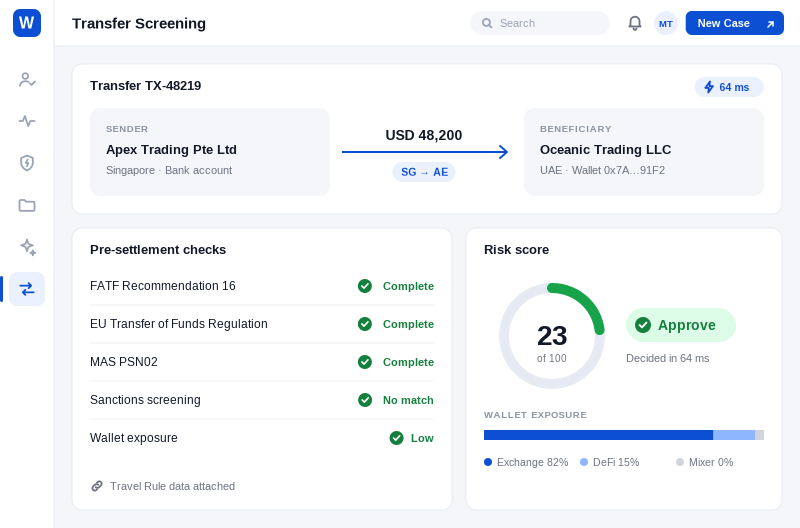
Crypto compliance covers verifying customers, screening wallets and on-chain transactions for exposure to sanctioned, stolen or mixed funds, monitoring deposits and withdrawals, and keeping records for licensing and reporting duties. WIDTH verifies the customer, screens every wallet, deposit and withdrawal, and keeps one audit trail. KYT traces funds up to 5 hops and screens USDT and USDC today.
- KYC
- full check in under 30 seconds · US$0.50 per check for digital asset businesses until 31 Dec 2026 (T&Cs apply)
- KYT
- traces up to 5 hops · 72 rules in 9 risk categories across 3 rulesets
- Coverage
- 8 chains · USDT and USDC screened and traced today
- Verdicts
- 0–100 score · Accept 0–19 · Review 20–49 · EDD 50–79 · Block 80–100
- Speed
- most screenings return within a minute; deep traces run asynchronously
- Travel Rule
- FATF Recommendation 16 stays your obligation; WIDTH does not send Travel Rule messages
Traditional-Finance Standards, On-Chain Speed
Customers expect to sign up and trade in minutes. Meanwhile, fake sign-ups, multi-accounting and impersonation keep rising, and funds from sanctioned, hacked or mixed sources arrive through intermediary wallets several hops away. Each licence, whether MAS in Singapore, the SFC in Hong Kong, MiCA in the EU or VARA in Dubai, sets its own onboarding, monitoring and reporting duties.
WIDTH brings identity and on-chain risk onto one platform, with a policy per jurisdiction. Your team sees who the customer is, where their money has been and what was decided, in one place.
Fast Onboarding, Without the Fraud
Every extra step loses customers; every gap lets in a borrowed ID or a repeat applicant.
Exposure Hidden in Fund Flows
The deposit address is clean; the money behind it passed through a mixer three hops back.
Evidence Years Later
Regulators and auditors ask why a customer or transfer was approved, long after the analyst who decided has moved on.
Who It's For
- Exchanges and brokers
- Custodians and wallet providers
- Tokenised-asset platforms
- Stablecoin, stored-value and payment providers
- OTC and liquidity desks
- Funds and asset managers
- DeFi protocols with an operating team
What You're Up Against
- Licensing obligations such as MAS, SFC, MiCA and VARA requirements
- FATF Recommendation 15 for virtual-asset service providers, and Recommendation 16 obligations on transfers
- Sanctions screening
- Suspicious transaction reporting
Problems It Solves
- Slow or leaky onboarding
- Indirect exposure to sanctioned, stolen or mixed funds
- Scores nobody can explain
- Deposit and withdrawal reviews by hand
- Evidence spread across tools
How WIDTH Fits
- KYC, KYB and on-chain screening on one customer record
- A policy per jurisdiction
- Web console, REST API and an MCP server for AI agents
- One audit trail
Across Your Customer Lifecycle
| Stage | WIDTH Product | What It Does for Digital Assets | Proof |
|---|---|---|---|
| Onboard | KYC Onboarding · KYB Onboarding | Verify retail customers in one flow; verify institutional clients and every UBO on one case. | < 30 s full KYC · 25% UBO threshold, configurable |
| Screen | KYT | Wallet admission: screen an address's own label and its upstream and downstream exposure before you whitelist it. | Up to 5 hops |
| Monitor | KYT · Transaction Monitoring | Deposits: trace the source of funds. Withdrawals: check the destination and downstream risk. Ongoing: re-screen addresses and watch customer behaviour across fiat and on-chain activity. | 0–100 score · Accept, Review, EDD, Block |
| Detect | Graph Intelligence | Join the wallet graph to fiat accounts, entities and devices, so one operator behind many accounts shows up as a network. | On-chain and off-chain in one graph |
| Investigate | Case Management · AI Reviewer · KYT tracing | Review, EDD and Block results open a case with the snapshot attached. After an incident, trace a transaction up to 10 hops to see where the funds went. | < 2 min per Level-1 alert |
| Decide and record | Case Management | Keep the verdict, the paths, the reviewer and the outcome on the customer record. | Immutable screening snapshots |
Running a DeFi protocol? Users bring self-custody wallets and you may hold no identity data. DeFi Shield screens the wallets that interact with your contracts, opens a case when risk is detected and keeps an append-only audit trail you can export as CSV or PDF. → Explore DeFi Shield
A Clean Address, a Dirty Path
How an incoming deposit moves from screening to a recorded decision.
- TriggerA verified customer requests a USDT deposit from a Tron address. The address has no label of its own.
- ScreeningThe inflow ruleset traces 3 hops back. A sanctions exposure is found at 3 hops (20% of outflow, +48) and a mixer exposure at 2 hops (41% of outflow, +34).
- Score82, Block. The snapshot records the parameters, the rules hit and the fund-flow graph.
- ContextThe customer passed KYC 4 months ago. Graph Intelligence shows the same device behind a second account.
- ReviewThe case opens with the snapshot attached. AI Reviewer drafts the assessment, and the compliance officer reviews it.
- DecisionThe deposit is rejected under the firm's policy, enhanced due diligence is opened on the customer, and a suspicious transaction report decision is recorded with its rationale.
Illustrative scenario · Demo data
Recommended Stack
Start with
Decisions Stay with Your Team
WIDTH verifies, traces, scores and recommends a verdict. Your system applies the action, and your team decides whether to accept, hold, apply EDD or reject funds, freeze assets, offboard a customer or file a report. Those decisions, and your licensing and reporting obligations, remain yours.
One Audit Trail for Every Wallet
When a regulator or auditor asks why a customer was onboarded or a transfer was accepted, the answer is on one record, years later.
- Sources
- FATF Recommendations (fatf-gafi.org) · MiCA (EU Markets in Crypto-Assets Regulation)
What Examiners Ask for, and Where It Is
- Who the customer is: KYC or KYB results, documents, UBOs and screening, with timestamps
- Why a wallet was accepted: the screening snapshot (parameters, ruleset version, rules hit, score, verdict)
- Where the funds came from or went: the fund-flow paths and the exported graph
- Who decided: case notes, reviewer, approver and outcome
- What changed over time: re-screening history and re-KYC triggers
Trusted by Regulated Institutions Since 2014
*Cumulative since 2014.
FAQ
What is crypto compliance?
Crypto compliance is the set of controls a virtual asset business uses to meet its AML, sanctions and licensing obligations: customer due diligence, wallet and transaction screening, monitoring, suspicious transaction reporting and record-keeping. It applies the standards of traditional finance to on-chain activity. WIDTH covers identity and on-chain risk on one record, with KYC, KYB, KYT screening and case management.
What crypto compliance obligations do VASPs have?
Virtual asset service providers (VASPs) are expected to apply customer due diligence, screen for sanctions, monitor transactions, report suspicious activity and keep records, under FATF Recommendation 15 and the licensing rules where they operate, such as MAS, SFC, MiCA or VARA requirements. Recommendation 16 adds information duties on transfers. WIDTH supports these obligations; meeting them remains the VASP's responsibility.
What is the Travel Rule?
The Travel Rule is FATF Recommendation 16 applied to virtual assets: VASPs must obtain, hold and send originator and beneficiary information with qualifying transfers. WIDTH does not send or receive Travel Rule messages, and the obligation stays with you. WIDTH keeps customer identity, wallet screening results and decisions on record, which your own Travel Rule process can draw on.
How does KYT score a crypto address?
WIDTH KYT traces the funds behind an address or transaction, matches the paths against 72 rules in 9 risk categories, and returns a 0–100 score with an Accept, Review, EDD or Block verdict. Default tracing looks 3 hops in and 1 out, configurable up to 5 each way. The screening snapshot records the parameters, the rules hit and the fund-flow graph.
Which chains and assets does WIDTH cover?
WIDTH KYT supports 8 chains and screens and traces USDT and USDC flows today. The live list of supported chains and assets is shown in the console. Most screenings return within a minute, and deep traces run asynchronously. After an incident, transaction tracing goes up to 10 hops, in batches of up to 500 transactions.
We hold licences in several markets. Can each run its own rules?
Yes. You can set a policy per jurisdiction in WIDTH and clone the built-in on-chain rulesets to match each licence's risk appetite. Each customer, wallet and transfer is then screened under the right policy, and the ruleset version behind every verdict is recorded in the screening snapshot.
What does the US$0.50 crypto KYC offer include?
For digital asset businesses until 31 Dec 2026, WIDTH offers a full KYC check (ID, 1:1 face match, passive liveness, and device and IP analysis) at US$0.50 per check, with wallet address and transaction screening included. Terms apply. Contact sales for volume pricing or for pricing after the offer ends.
Which WIDTH products do digital asset businesses start with?
Most digital asset businesses start with KYC Onboarding, KYT and Case Management, so customers, wallets and decisions sit on one record. Institutional desks add KYB Onboarding for corporate clients and their UBOs, Graph Intelligence helps with multi-accounting and fund networks, and AI Reviewer with alert backlogs. Protocols with self-custody users start with DeFi Shield.
Does WIDTH decide for us?
No. WIDTH returns findings, scores and a recommended verdict, and your system applies the action. Your team decides whether to accept, hold, apply EDD or reject funds, freeze assets, offboard a customer or file a report. Those decisions, and your licensing and reporting obligations, remain yours.
See How WIDTH Fits Your Digital Asset Business
Onboard a live customer and screen a live address with the WIDTH team, from selfie to verdict to audit trail.
AI on the work. People on the decision. Evidence on the record.