Know Where the Funds Came from Before You Accept Them

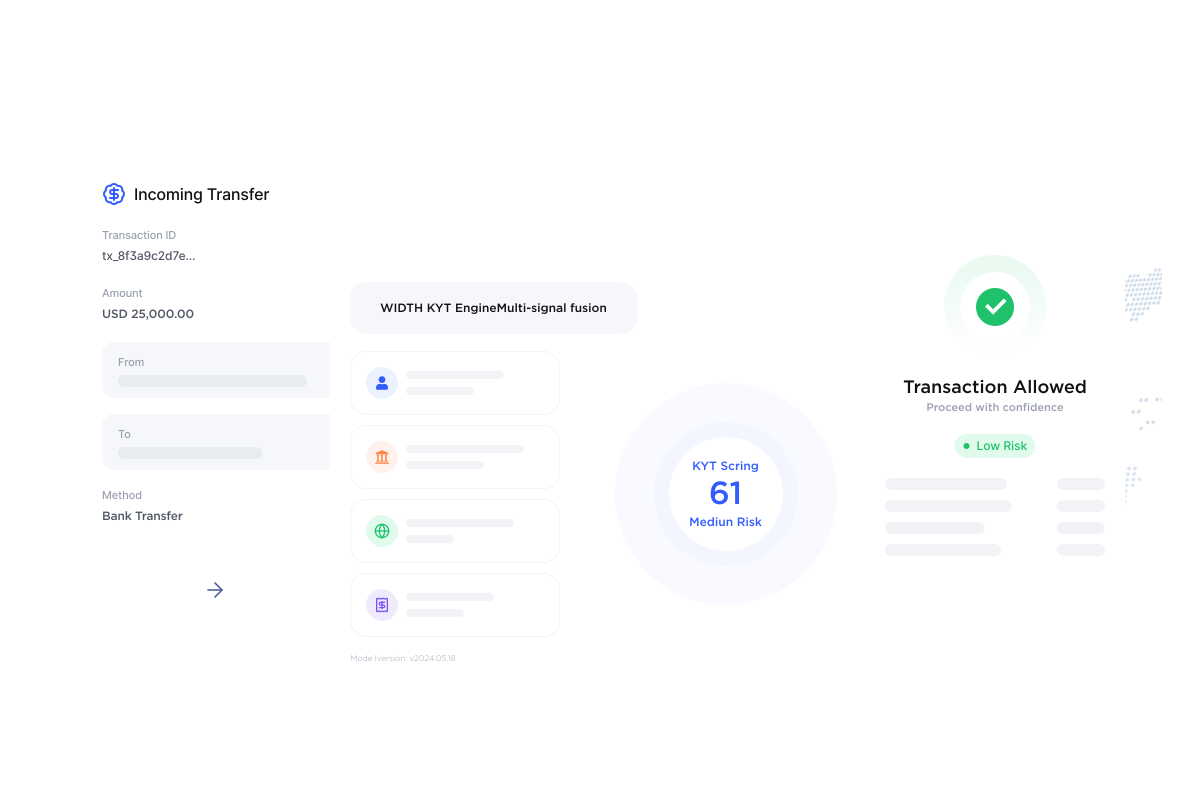
A deposit address can look clean while the money behind it passed through a mixer or a sanctioned wallet three hops ago. KYT traces the funds behind an address or transaction, scores the risk 0–100 against your rules, and tells you whether to accept, review, apply EDD or block, with every path on record.

KYT: crypto transaction screening you can explain

Built for exchanges, brokers, custodians, payment firms and licensed VASPs

0–100 risk score · 4 verdicts: Accept, Review, EDD, Block · 3 rulesets: address, inflow, outflow · 10 hops for transaction tracing

Supported chains and assets are listed live in the console. Most screenings return within a minute; deep traces can run asynchronously.

What is Crypto Transaction Screening (KYT)?

Crypto transaction screening, or KYT (know your transaction), checks where the funds behind a blockchain address or transfer have been, to find exposure to sanctioned, stolen or mixed funds before a business accepts or releases them. WIDTH KYT traces USDT and USDC flows up to 5 hops, scores risk 0–100 against 72 rules, and returns Accept, Review, EDD or Block.

Assets screened today
USDT and USDC · Chains: 8
Tracing depth
up to 5 hops in and out for screening (default 3 in, 1 out); up to 10 hops for transaction tracing
Rules
72 rules in 9 risk categories, across 3 rulesets (address, inflow, outflow)
Score and verdicts
0–100; Accept 0–19, Review 20–49, EDD 50–79, Block 80–100
Speed
most screenings return within a minute; deep traces run asynchronously
Labelled addresses
500M+ in the target dataset

The Risk is Rarely in the Wallet You Can See

Sanctioned and stolen funds are rarely sent straight to you. They are layered through intermediaries, mixers and bridges until the address that reaches your platform has no label of its own. A list check on that address says "clean". The money says otherwise.

KYT follows the funds back and forward through labelled counterparties, so your team decides on where the money has been, not just on the last address it touched.

Exposure Hidden Behind Hops

Direct-only screening misses funds routed through one or two intermediaries.

Scores Nobody Can Explain

A risk number without the path and the rule behind it won't hold up in a review or an examination.

Rules You Can't Change

Your risk appetite differs by product and market, but most tools give you one fixed model.

Who It's For

  • Centralised exchanges and brokers
  • Custodians and wallet providers
  • Payment and stored-value firms handling stablecoins
  • Tokenised-asset platforms
  • Licensed VASPs

Problems It Solves

  • Indirect exposure to sanctioned, stolen or mixed funds
  • Unexplainable risk scores
  • Fixed rules that don't match your risk appetite
  • No record of why a deposit was accepted

Where It Fits

Screen and Monitor. Screen at wallet admission, deposit and withdrawal; re-screen on a schedule. Hits go to Case Management, and the wallet graph joins fiat accounts in Graph Intelligence.

How It Fits Your Stack

  • Web console
  • REST API, synchronous or asynchronous
  • MCP server with 19 tools, so AI agents can screen and manage rules
  • Results in a widely used industry response format

Which one do I need?

KYT vs DeFi Shield

KYT is for businesses that hold customer accounts and decide whether to accept or release funds. DeFi Shield is for protocols whose users connect self-custody wallets.

KYT vs Transaction Monitoring

KYT screens the on-chain path behind an address or transfer. Transaction Monitoring finds behavioural patterns across a customer's fiat and on-chain history. Most digital asset teams use both.

What You Get

Fund-Flow Tracing, Not Just a List Check

Problem
The address at your door has no label of its own.
What WIDTH does
Traces inflows and outflows up to 5 hops through labelled counterparties. The daily default is 3 hops in and 1 out, and you can go deeper when a case needs it.
Result
Direct links, layered exposure and the address's own label are all found and scored.

A Score You Can Explain Line by Line

Problem
A number without a reason is a liability.
What WIDTH does
Every rule hit adds to a 0–100 score. Each hit is weighted by its severity, by how close the risk is (direct or layered) and by the share of the address's funds involved. The score maps to Accept (0–19), Review (20–49), EDD (50–79) or Block (80–100). A sanctions label on the address itself scores the maximum.
Result
Every score traces back to specific rules, paths and transactions.

Rules You Control

Problem
One fixed model can't match every product and market.
What WIDTH does
Three built-in rulesets (address, inflow and outflow) share 72 rules across 9 risk categories. Built-ins stay read-only. Clone them, adjust severity, action, direction or hop band, add your own rules, and star the ones you want to see first.
Result
Screening that reflects your risk appetite, with every version on record.

Trace a Transaction and See Where the Money Went

Problem
After an incident, you need to know where the funds are now.
What WIDTH does
Traces from a transaction, an address or a batch of up to 500 transactions, up to 10 hops. It then estimates whether the funds are still held, reached high-risk addresses or exchanges, crossed chains or were swapped.
Result
Faster answers for investigations, recoveries and law-enforcement requests.

See Why an Address Scored the Way It Did

The score, the verdict, the rules that fired and the fund-flow graph sit on one screen.

  • Every Path, Every RuleSee which rule fired at which hop, and the share of funds involved.
  • Fund-Flow GraphFollow the money visually and export the graph.
  • Snapshot on RecordEach screening is saved with its parameters and can't be changed.

How It Works

Path A · Screen an Address

  1. SubmitEnter an address in the console, send it by API, or let an AI agent call it through the MCP server.
  2. TraceKYT follows inflows and outflows through labelled counterparties to the hop depth you set.
  3. MatchEach path is checked against the rules in your chosen ruleset.
  4. ScoreHits add up to a 0–100 score and a verdict: Accept, Review, EDD or Block.
  5. RecordThe result is saved as an immutable snapshot.

Path B · Trace a Transaction

  1. StartFrom a transaction, an address or a batch of up to 500 transactions.
  2. FollowUp to 10 hops. By default the trace stops at bridges and exchanges.
  3. LocateSee where the funds are likely to be now: held, at high-risk addresses, at exchanges, cross-chain or swapped.
Also in the console: exchange flows
See an exchange's stablecoin deposits and withdrawals over 7, 30 or 90 days, or a custom range of up to 180 days. Counterparties are scored with the default rulesets.

Decisions Stay with Your Team

KYT traces, scores and recommends a verdict. Your system and your team decide whether to accept, hold, apply enhanced due diligence or reject funds, freeze assets or file a report. Those decisions, and reporting to regulators, remain your responsibility.

Every Screening, Saved as It Happened

Each screening is stored as an immutable snapshot, with the parameters used and the full result. Retrieve any snapshot by ID in the console or through the API, and export the fund-flow graph for a case file.

Captured

  • Address or transaction and chain
  • Screening parameters (hops, time window, minimum amount)
  • Ruleset and version
  • Rules hit, with hop, direction and share of funds
  • Score and verdict
  • Fund-flow graph
  • Timestamp
  • Snapshot ID, to retrieve it in the console or through the API
Supports your obligations under
FATF Recommendations 15 and 16 for virtual assets, and local requirements for digital payment token services, through rules you configure.
Sources
FATF Recommendations (fatf-gafi.org)

Trusted by Regulated Institutions Since 2014

500+regulated institutions*
180+jurisdictions*
ISO/IEC 27001certified
ISO/IEC 27701certified

*Cumulative since 2014.

Before You Get Started

What is KYT in crypto?

KYT (know your transaction) in crypto is the screening of blockchain addresses and transfers to see where the funds came from and where they went, so a business can spot exposure to sanctioned, stolen or mixed funds. It complements KYC, which checks the customer. WIDTH KYT traces USDT and USDC flows up to 5 hops and returns a 0–100 score with a verdict: Accept, Review, EDD or Block.

What is the difference between KYT and KYC?

KYC (know your customer) verifies who a customer is. KYT (know your transaction) checks the funds that customer sends or receives on-chain: where the money came from and where it went. Digital asset businesses usually need both, KYC at onboarding and KYT at deposits and withdrawals. WIDTH offers both, and digital asset businesses on the US$0.50 KYC offer get wallet address screening included until 31 Dec 2026 (T&Cs apply).

What is a hop in blockchain tracing?

A hop is one step between two blockchain addresses: funds sent directly from one address to another are one hop, and funds that pass through an intermediary on the way are two hops. Counting hops shows how close an address is to a risky source. WIDTH KYT traces inflows and outflows up to 5 hops for screening and up to 10 hops when tracing a transaction.

Is crypto transaction screening (KYT) required for VASPs?

Most regulators do not name a KYT tool, but virtual asset service providers must monitor transactions as part of their AML obligations. FATF Recommendation 15 applies AML/CFT requirements to VASPs, and local regulators set the detail, for example for digital payment token services. Many VASPs use KYT to meet part of those obligations. WIDTH KYT supports them; meeting them stays the VASP's responsibility.

Who is KYT built for?

WIDTH KYT is built for businesses that accept or release crypto funds for customers: exchanges, brokers, custodians, payment firms and licensed VASPs. Protocols whose users connect self-custody wallets use DeFi Shield instead. It is used at wallet admission, deposit and withdrawal.

Which chains and assets does KYT cover?

WIDTH KYT supports 8 chains and screens USDT and USDC flows. For EVM addresses it can check every supported chain automatically and screen only the active ones. The live list of chains and assets is in the console. Screening and tracing currently cover USDT and USDC.

How is the KYT risk score calculated?

Each rule hit is weighted by severity, by how close the risk is and by the share of the address's funds involved. Hits add up to a score capped at 100. In WIDTH KYT, 0–19 is Accept, 20–49 Review, 50–79 EDD and 80–100 Block, and a sanctions label on the address itself scores the maximum.

Can we change the KYT rules?

Yes. WIDTH KYT's built-in rulesets are read-only, but you can clone them, adjust severity, action, direction or hop band, add your own rules and star the hits you care about most. Every version is kept on record. The 72 built-in rules cover 9 risk categories.

How fast is crypto transaction screening with KYT, and how do we integrate it?

Most screenings return within a minute. Deep traces can run asynchronously and return a job ID to poll. Use the REST API, the web console or the MCP server, whose 19 typed tools let AI agents screen addresses, read results and manage rulesets and rules. All three share the same account, quota and snapshots. API responses follow a widely used industry format, so existing integrations can move with little change.

Does KYT block funds for us?

No. WIDTH KYT returns a verdict and the evidence behind it. Your system applies the action, and your team decides on holds, rejections, freezes and reports, which remain your responsibility. Each screening is saved as an immutable snapshot for your records.

See How It Fits Your Deposit and Withdrawal Flow

Screen a live address with the WIDTH team and walk through the score, the paths and the snapshot.

AI on the work. People on the decision. Evidence on the record.