Expose the Hidden Network Behind Every Alert

Mule rings, shell-company layers and cross-account layering are built to look ordinary one record at a time. Graph Intelligence maps the links between entities, accounts and transactions, so your team sees the network that single alerts miss.

Graph analytics for AML | WIDTH Graph Intelligence

Built for AML, fraud and investigations teams in banks, payment firms and digital asset businesses

Case figures are from an illustrative scenario with demo data. Hop depth for wallet exposure applies to on-chain screening through KYT.

What is Graph Analytics for AML?

Graph analytics for AML maps the links between people, companies, accounts, devices and transactions, so investigators can see networks that single alerts miss. WIDTH Graph Intelligence builds three connected graphs (identity, transaction and company ownership) from your data in WIDTH, connected with help from the WIDTH team. When on-chain data is joined through KYT, indirect wallet exposure is traced up to 5 hops.

Graphs
3 connected graphs: identity, transaction and company ownership
Illustrative case
4 patterns found that no single alert showed (circular ownership, cross-border layering, sanctions proximity, shared device and IP) · demo data
On-chain exposure
traced up to 5 hops when wallet data is joined through KYT
Explainability
every link cited with its source and date; every flag replays the path behind it
Reports
draft STR-ready summary; your investigator reviews and approves
Company
500+ regulated institutions* · 180+ jurisdictions* · ISO/IEC 27001 and 27701 certified
Financial Crime Hides in the Connections

Rules and screening look at one customer or one transaction at a time. Organised crime is designed for exactly that: each account stays under the threshold, each company looks clean, and each transfer is unremarkable.

Per-alert monitoring sees dots. Graph Intelligence sees the network.

Mule and Smurfing Rings

Funds are split across many low-value accounts to stay under thresholds.

Shell-Company Layers

Ownership and control are hidden behind nested entities and nominee owners.

Cross-Account Layering

Value hops between accounts, payment rails and wallets mid-flow.

Who It's For

  • AML and financial crime investigators
  • Fraud teams
  • KYB and enhanced due diligence teams
  • Banks, payment firms, remittance and digital asset businesses

Problems It Solves

  • Mule and smurfing rings
  • Hidden beneficial owners
  • Cross-border and cross-rail layering
  • Multi-accounting through shared devices
  • SAR narratives built by hand

Where It Fits

Detect and Investigate. Draws on Onboarding, Screening, Transaction Monitoring and KYT, and feeds Case Management.

How It Fits Your Stack

Uses your data in WIDTH; the WIDTH team helps connect it to the graph.

What You Get

One Graph Across Everything You Already Hold

Problem
Identity, ownership, transaction and wallet data sit in separate systems.
What WIDTH does
Builds three connected graphs (identity, transaction and company ownership) and joins on-chain wallets to fiat accounts and entities.
Result
One view of who is connected to whom, and how money moves between them.

Rings and Hidden Owners, Found

Problem
Each account in a ring looks clean on its own.
What WIDTH does
  • Resolves duplicate identities across records and sources;
  • Traces paths several steps out from any subject;
  • Detects communities, mule rings and circular ownership;
  • Spreads risk scores across connected nodes.
Result
A clean-looking customer one step from a sanctioned entity no longer slips through.

Findings You Can Put in a Report

Problem
A graph nobody can explain doesn't help an investigation.
What WIDTH does
Cites every connection with its source and makes every path replayable. Findings compile into an STR-ready summary with recommended actions for your investigator to review.
Result
Evidence that stands up in a SAR or STR, not just a picture.

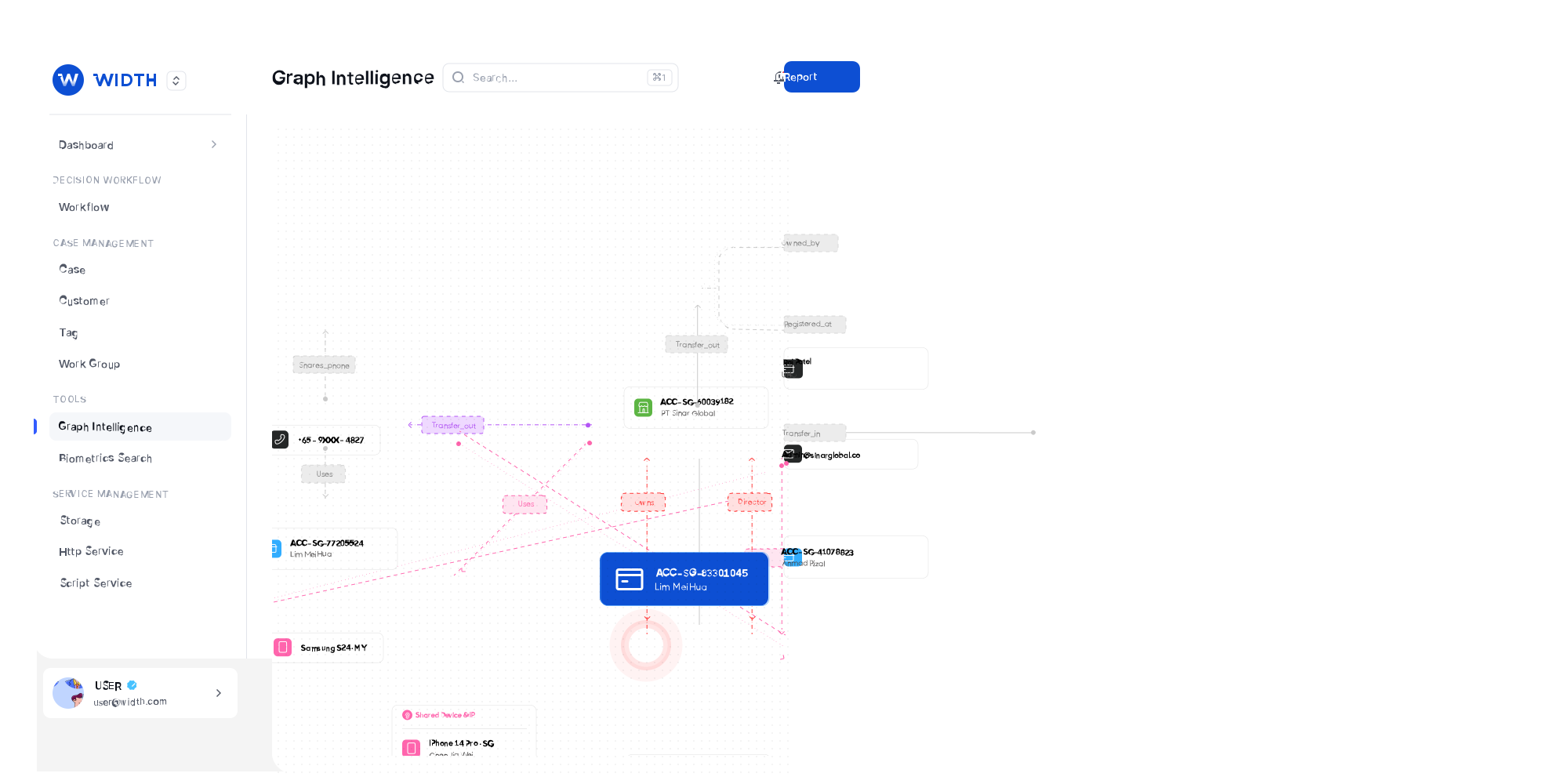
See a Case the Way the Network Sees It

One subject and four patterns that no single alert showed. Every link is labelled with where it came from.

  • Patterns, Not Single AlertsRings, layering and shared infrastructure, in one view.
  • Every Link ExplainedClick any edge to see its source and date.
  • A Draft, Not a DecisionYour investigator reviews and approves the report.

How It Works

  1. ResolveDe-duplicate and link identities across records and sources: names, documents, phones, emails, devices, IP addresses and addresses.
  2. ConnectJoin customers, companies, directors, owners, accounts, transactions and wallets into three graphs: identity, transaction and company ownership.
  3. TraceFollow paths several steps out from any subject, across accounts, borders, payment rails and blockchains.
  4. DetectSurface communities, mule rings, circular ownership and hidden beneficial owners. Risk propagates across connected nodes.
  5. Explain and ActCarry the network into a case, with every path cited and replayable, and a draft STR summary for your investigator to review.

Decisions Stay with Your Team

Graph Intelligence finds connections and scores the risk they carry. It does not decide that a connection is criminal. Your investigators review the paths, decide what to escalate, and own any report or restriction that follows.

Every Connection Cited and Replayable

Network findings carry their evidence into the case, so a reviewer, an auditor or a regulator can follow the same path your investigator did.

Captured

  • Each node and link, with its source and date
  • The path that triggered each flag
  • Risk scores and how they propagated
  • The investigator's notes and decision
  • The approved report
AI assistance
WIDTH drafts a summary of the network findings and recommended actions. Your investigator reviews, edits and approves it before use.

Trusted by Regulated Institutions Since 2014

500+regulated institutions*
180+jurisdictions*
ISO/IEC 27001certified
ISO/IEC 27701certified

*Cumulative since 2014.

Before You Get Started

What is graph analytics for AML?

Graph analytics for AML is the analysis of relationships between customers, companies, accounts, devices and transactions, rather than each record on its own. It shows patterns such as mule rings, circular ownership and layering that only appear across several entities. WIDTH Graph Intelligence builds three connected graphs (identity, transaction and company ownership) and cites the source of every link, so investigators can explain what they found.

What is entity resolution?

Entity resolution is the process of working out which records belong to the same real person or company, even when names, documents or contact details differ slightly. Without it, one person with three accounts looks like three customers. WIDTH Graph Intelligence resolves identities across records and sources using names, documents, phones, emails, devices, IP addresses and addresses, then links them in the identity graph.

How does graph analysis find money mule networks?

Graph analysis finds money mule networks by connecting accounts that look unrelated on their own but share devices, IP addresses, beneficiaries or fund flows. A mule ring usually splits funds across many low-value accounts to stay under thresholds, so no single transfer raises an alert. WIDTH Graph Intelligence detects these communities, spreads risk across connected nodes and shows the whole ring in one view for your investigator to review.

How is graph analytics different from rules and screening?

Rules and screening score one customer or one transaction at a time, while graph analytics scores the relationships between them. Risk that only shows up across several entities, such as a clean-looking customer one step from a sanctioned company, becomes visible. WIDTH Graph Intelligence works alongside Screening, Transaction Monitoring and KYT, drawing on their results rather than replacing them.

What data does Graph Intelligence use?

Graph Intelligence uses your data in WIDTH: KYC and KYB records, company ownership data, transactions, device and session signals, screening results, on-chain wallet data and case outcomes. The WIDTH team helps connect your data to the graph and agrees with you which sources to include.

Can graph analytics find hidden beneficial owners?

Yes. WIDTH Graph Intelligence follows ownership and control links across companies and people in the company ownership graph, including layered and circular holdings. It flags networks that concentrate risk even when each entity looks clean on its own, such as a person who owns and directs the company paying him. Your team then decides whether enhanced due diligence is needed.

Is Graph Intelligence explainable?

Yes. Every node and link in WIDTH Graph Intelligence carries its source and date, and every network flag replays the exact path that produced it. A reviewer, auditor or regulator can follow the same path your investigator did, and the evidence carries into the case with the investigator's notes and decision.

Who is Graph Intelligence built for?

WIDTH Graph Intelligence is built for AML, fraud and investigations teams in banks, payment and remittance firms, and digital asset businesses. KYB and enhanced due diligence teams also use it to see beneficial ownership across corporate clients. It works on your data in WIDTH, which the WIDTH team helps you connect.

Does Graph Intelligence file reports for us?

No. WIDTH Graph Intelligence drafts an STR-ready summary of the network findings with recommended actions, such as filing a report or applying enhanced due diligence. Your investigator reviews, edits and approves the summary, and your team decides what to file. Graph Intelligence finds connections and scores their risk; it does not decide that a connection is criminal.

See What Your Alerts are Missing

Bring a known case, and we'll map the network behind it, from hidden links to a report-ready summary.

AI on the work. People on the decision. Evidence on the record.