What Does AML Compliance for Law Firms and Accountants Involve?
AML compliance for law firms and accountants covers verifying clients, tracing corporate clients to their beneficial owners, screening every party, assessing risk before acceptance and keeping the client file current. WIDTH brings intake, KYC, KYB, screening and partner sign-off onto one engagement record, then keeps it under review. Each director and UBO gets a KYC decision in under 30 seconds.
- Record
- 1 case per client, holding every party, document, check and decision
- UBO threshold
- 25% by default, configurable
- Director and UBO KYC
- a decision for each in under 30 seconds
- Review triggers
- director or shareholder change, new sanctions or adverse media, transaction anomaly, periodic review
- Reviews
- next review in 12 months, or sooner on a change
- Coverage
- 8 scripts matched natively in screening · 16,000+ ID document types
Client Acceptance Shouldn't Depend on Five Tools and an Inbox
Professional firms are gatekeepers. They form companies, hold client money, structure transactions and act as directors and nominees, which is why regulators treat them as designated non-financial businesses and professions. Yet client acceptance often runs on a screening tool, a registry search, a conflicts database, a spreadsheet and an email chain.
WIDTH puts the client, its entities, its owners, the screening results, your conflict-check result and the partner's approval on one engagement record. Then it keeps that record under review.
Ownership Rebuilt by Hand
Corporate clients bring nested shareholdings across several jurisdictions, and someone traces them in a spreadsheet.
Checks That Don't Join Up
Screening results, conflict searches and ownership charts sit outside the CDD file, so the reviewer can't see the whole client.
Files That Go Stale
Directors change, owners become PEPs and adverse media appears long after acceptance, and nobody looks until the next periodic review.
Who It's For
- Law firms
- Accounting and audit firms
- Trust and corporate service providers
- Consulting and advisory firms
What You're Up Against
- Obligations such as FATF Recommendations 22 and 23 for DNFBPs
- Local CDD rules for corporate service providers, lawyers and accountants
- Professional conflict rules
Problems It Solves
- Ownership traced by hand
- Checks spread across tools
- Inconsistent acceptance decisions across offices
- Files rebuilt before inspections
- Stale client records
How WIDTH Fits
- One customer link collects every party, document and form
- Your conflict-check result attached to the same record
- Partner and committee approval paths
- The WIDTH dashboard, with no build needed
Across Your Customer Lifecycle
| Stage | WIDTH Product | What It Does for Professional Firms | Headline Number |
|---|---|---|---|
| Onboard | KYC Onboarding · KYB Onboarding | Verifies individual clients, and traces corporate clients through every layer to the UBOs | < 30 s KYC per director and UBO · 25% UBO |
| Screen | Screening (in KYC and KYB) | Screens clients, directors, shareholders and UBOs against sanctions, PEP and adverse media | 8 scripts matched natively |
| Monitor | KYB ongoing review | Reopens the file when a trigger fires, and collects only what changed | 12-month review, sooner on a change |
| Detect | Graph Intelligence | Surfaces shared directors and UBOs across your client base | — |
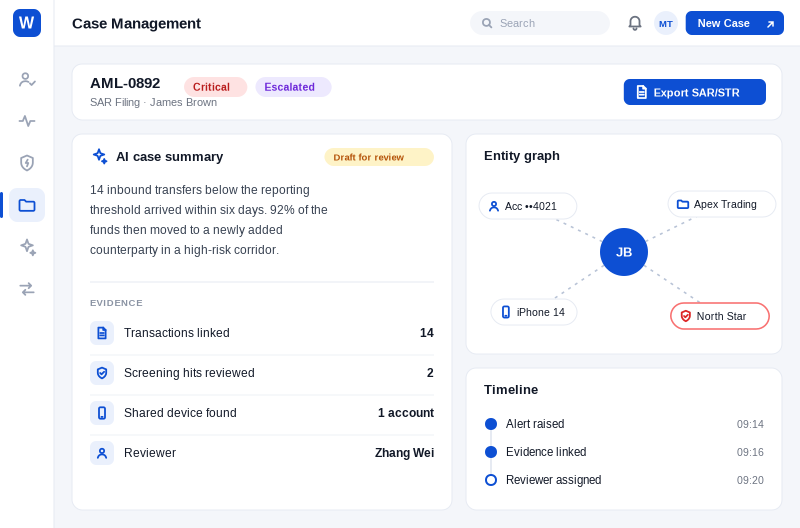
| Investigate | AI Reviewer · Case Management | Prepares screening and review alerts with the client's full context; your reviewer decides | < 2 min per alert decision |
| Decide and record | Case Management | Records who accepted the client, on what basis and under which policy version | — |
One New Client, from Intake to Ongoing Review
- PartiesHalden Advisory Pte Ltd and two directors; identities verified, liveness passed
- OwnershipThree-layer structure traced to two UBOs above 25%
- ScreeningSanctions, PEP and adverse media clear on all four parties; one name match resolved
- ConflictsThe firm's conflict search result is attached to the record
- RiskMedium; approved by the engagement partner under the firm's acceptance policy
- Ten months laterA registry update shows a new shareholder, so the case reopens, the shareholder is verified and screened, and the file is approved again with the next review set at 12 months
Illustrative scenario · Demo data
Recommended Stack
Start with
Add When You Need It
Corporate Service Providers
- see also the dedicated CSP solution.
Decisions Stay with Your Team
You define the risk categories, the acceptance criteria, the conflict rules and who signs off. WIDTH collects, verifies, traces, screens and prepares. Your partners and compliance officers decide whether to accept a client or matter. Each firm remains responsible for its professional obligations and any reporting.
Audit-Ready as You Decide
A completed check is only useful if the firm can later show what was reviewed and how the decision was reached. WIDTH builds the evidence pack as the review happens, instead of reconstructing it before an inspection.
- Sources
- FATF Recommendations (fatf-gafi.org)
Captured
- What was checked: client and entity information, screening, ownership and conflict results
- Who reviewed the file: the reviewer, approvals, escalations and questions raised
- Which policy applied: the policy version and risk assessment in force
- What was decided: the engagement decision and its evidence
- Every later review and what triggered it
- Who signed off: the partner's approval of the engagement
Trusted by Regulated Institutions Since 2014
*Cumulative since 2014.
FAQ
What is a DNFBP?
A DNFBP is a designated non-financial business or profession: a business outside banking that FATF expects to apply AML controls because it can be misused to launder money. The category includes lawyers, notaries, accountants, trust and company service providers, real estate agents, casinos, and dealers in precious metals and stones. FATF Recommendations 22 and 23 set out their due diligence and reporting duties.
What AML obligations do law firms and accountants have?
Law firms and accountants generally need to verify clients, identify beneficial owners, screen for sanctions and PEPs, assess risk before acceptance, keep records and report suspicious transactions when they carry out covered work, such as forming companies, managing client money or acting in property transactions. These duties follow FATF Recommendations 22 and 23 and local CDD rules. WIDTH supports them; each firm remains responsible.
What is client due diligence for professional firms?
Client due diligence (CDD) for professional firms is the set of checks a firm completes before accepting a client or matter: who the client is, who owns and controls it, whether any party is sanctioned or a PEP, and what risk the engagement carries. WIDTH collects every party and document through one customer link and keeps the checks, risk assessment and partner approval on one engagement record.
Can WIDTH trace complex ownership structures?
Yes. WIDTH expands corporate shareholders through each layer until it reaches the natural persons above your threshold, which is 25% by default and configurable. Every UBO is verified and screened on the same case. Each layer is recorded, so the reviewer and any inspector can see how the ownership was traced.
What keeps a client file current after acceptance?
In WIDTH, you switch on the review triggers you need: a director or shareholder change, a new sanctions or adverse media hit, a transaction anomaly, or a periodic review. When one fires, the case reopens and only what changed is collected. Otherwise the next review falls 12 months after the last one.
Does WIDTH run conflict checks?
No. Conflict searches stay in your firm's own system. You can attach the conflict result to the WIDTH engagement record as a document, so the reviewer sees it next to the CDD file, identity checks and screening results, and it is kept with the acceptance decision for audit.
Is WIDTH set up for law firms and accountants, or only CSPs?
WIDTH is set up for all four kinds of firm: law firms, accounting and audit firms, trust and corporate service providers, and advisory firms. The checks, policies and approval paths are configured for your profession, jurisdiction and services. WIDTH also has a dedicated solution for corporate service providers.
Which WIDTH products do professional firms start with?
Most professional firms start with KYB Onboarding for corporate clients, with each director and UBO verified through KYC on the same case, and KYC Onboarding for individual clients. Firms often add AI Reviewer for screening and review alerts and Graph Intelligence to see shared directors and owners across clients.
Does WIDTH decide whether we accept a client?
No. WIDTH runs the checks and recommends based on your acceptance criteria. Your partner or committee makes the acceptance decision, and it is recorded against them with the policy version in force. Each firm remains responsible for its professional obligations and any suspicious transaction reporting.
See How WIDTH Fits Your Firm
Take a new corporate client through intake with our team, from customer link to UBO to partner approval.
AI on the work. People on the decision. Evidence on the record.